A patent drawing has one important job: make the invention easier to understand. It should show the structure, relationship, and important features of an invention without creating confusion. This becomes especially important when an invention contains internal parts, curved surfaces, different materials, or complicated assemblies.
One of the techniques that can improve this visual communication is Hatching and Shading in Patent Drawings. When used correctly, these techniques can help readers understand sectional views, surface differences, depth, and three-dimensional features.
However, hatching and shading should not be added simply to make a drawing look attractive. Patent illustrations are technical documents, so every line and visual effect should have a clear purpose.
What Does Hatching Mean in a Patent Drawing?
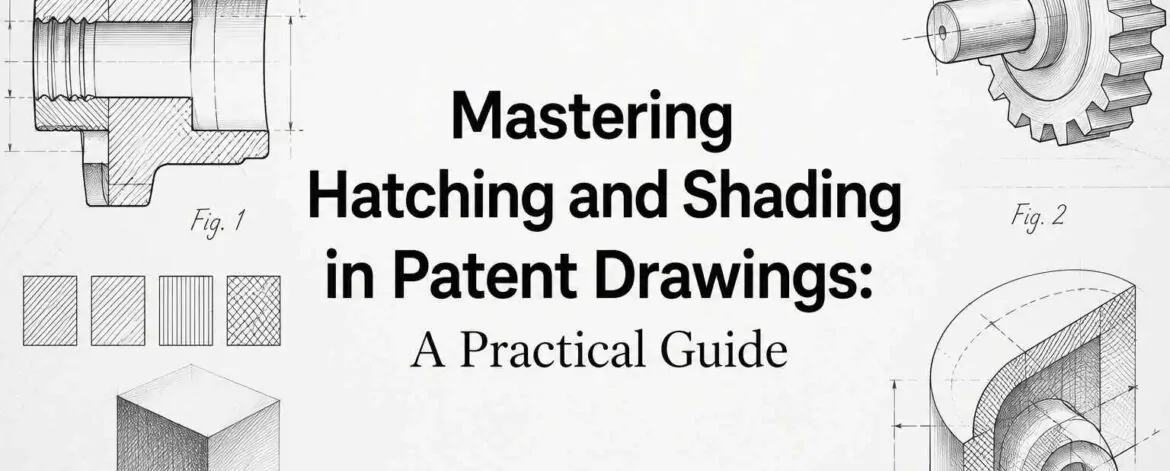
Hatching generally consists of repeated lines placed across a surface that has been exposed by a sectional cut. It allows the reader to recognize that the illustrated area represents a cut surface rather than an empty portion of the invention.
For example, consider a device with a metal outer casing and several components positioned inside it. If the drawing includes a cross-section, the exposed wall of the casing can be represented with hatch lines. This immediately helps distinguish the casing from the internal space.
The technique is particularly useful for mechanical inventions, tools, equipment, housings, assemblies, and other products where internal construction is important.
Why Is Hatching Useful for Sectional Views?
Why can’t a sectional view simply show the components without hatching?
It can, but the result may be harder to interpret.
A sectional figure removes part of an object to reveal what is inside. Once that happens, the reader needs some indication of which areas represent material and which represent open space. Hatching provides that visual distinction.
A well-prepared sectional view can therefore communicate information that may take several sentences to explain in writing.
Hatching can help identify:
- Cut surfaces
- Solid portions of a component
- Internal walls
- Adjacent structures
- Material boundaries
- Relationships between internal components
The important point is that the hatch pattern should support the figure instead of competing with it.
What Is Shading Used for?
Shading serves a different visual purpose.
While hatching is commonly associated with sectional areas, shading can help communicate the shape and depth of a component. A carefully placed shade can make a curved, recessed, raised, or angled surface easier to recognize.
For instance, a patent drawing showing a curved housing may look almost flat if every surface is represented using identical line treatment. Appropriate shading can provide additional visual information about the shape.
But there is an important rule: clarity should always come before appearance.
Patent drawings are not product advertisements. A highly decorative illustration may look impressive but still fail to communicate the invention effectively.
Hatching vs. Shading: What Is the Difference?
Are hatching and shading interchangeable?
Not exactly.
Hatching is primarily a line-based technique used to indicate sectional surfaces or distinguish certain areas. Shading is generally used to suggest depth, form, contours, or surface characteristics.
Understanding this difference helps a draftsman decide what treatment is appropriate for a particular figure.
A cross-sectional mechanical component may require clear hatch lines, whereas a perspective view of the same component might use limited shading to communicate its three-dimensional form.
How Should Hatch Lines Be Prepared?
The quality of hatch lines can influence how quickly someone understands a sectional figure.
The lines should be clean and consistently arranged. If one area contains tightly packed lines while another has widely separated lines without a reason, the figure may appear inconsistent.
A draftsman should also consider the size of the component. A very small part may not have enough room for dense hatching. In such cases, the drawing needs to remain readable rather than forcing a hatch pattern into every available space.
Reference numerals are another consideration. Hatch lines should not make important numbers, arrows, or boundaries difficult to recognize.
Can Shading Make a Patent Drawing Too Complicated?
Yes.
One of the biggest problems with shading is using more than the drawing actually needs.
Imagine a device containing ten different components. If every surface receives heavy shading, the resulting figure can become visually crowded. Important edges may disappear, reference numbers may become difficult to read, and the overall structure may be harder to identify.
Good patent illustration is often about knowing what not to add.
A professional draftsman evaluates whether shading genuinely improves understanding. If removing a particular shade makes the figure clearer, removing it may be the better choice.
What Are Common Hatching and Shading Mistakes?
What problems should inventors look for before approving patent drawings?
Several issues can reduce the effectiveness of a figure.
1. Inconsistent Hatch Directions
Random changes in hatch direction can make adjacent areas difficult to distinguish. Consistency is particularly important when several sectional components appear together.
2. Excessive Line Density
Too many lines can hide the structure underneath. Hatch lines should remain light enough and spaced appropriately for the figure.
3. Heavy Shading
Dark shading can cover boundaries and small technical features. This is especially problematic in complex illustrations.
4. Poor Placement Around Reference Numerals
A reference number must remain readable. Lines or shading that pass directly through important identifying information can reduce clarity.
5. Decorative Effects
Patent figures should not be treated like commercial product renders. Unnecessary gradients, artistic shadows, and visual effects can distract from the technical subject.
How Do Patent Offices View Drawing Quality?
Do patent offices have requirements for patent drawings?
Yes. Patent offices establish formal requirements that applicants need to consider when preparing application drawings. Requirements can vary according to the jurisdiction and type of application.
For applicants working with the USPTO, EPO, or WIPO-related filing processes, understanding the applicable drawing standards is important.
This is one reason professional patent drafting can be useful. A drawing may accurately represent an invention but still require adjustments to meet formal presentation expectations.
Patent drawings should therefore be prepared with both technical accuracy and filing requirements in mind.
Why Is Professional Drafting Important?
Can an inventor prepare patent drawings alone?
In some simple cases, an inventor may be able to create an initial sketch. However, turning that sketch into a professional patent illustration can require a different level of technical understanding.
A patent draftsman works with information such as:
- Inventor sketches
- Engineering drawings
- CAD files
- Product photographs
- Technical descriptions
- Existing design concepts
- Component relationships
The draftsman then develops figures that present those details in a consistent and understandable format.
This can be especially helpful for inventions involving complicated assemblies where a simple perspective view is not enough.
How Can Inventors Prepare Better Source Material?
What should an inventor provide to a patent drawing professional?
The better the technical information, the easier it is to develop useful figures.
Inventors should identify the parts that are important to the invention and explain how those parts interact. Sketches do not need to be beautiful. Even rough drawings can be useful when they clearly show the inventor’s concept.
Photographs, CAD models, dimensions, operating positions, and notes about internal mechanisms can also help the draftsman understand what needs to appear in the final figures.
The inventor should also point out features that are considered essential to the invention so they are not overlooked during illustration.
How Does Good Visual Communication Strengthen a Patent Application?
A strong patent drawing can provide information that words alone may not communicate quickly.
A reader can look at a figure and identify the position of components, the shape of a housing, the arrangement of internal parts, or the relationship between different elements.
This is where Hatching and Shading in Patent Drawings can become valuable. Rather than adding visual decoration, these techniques can guide the reader toward the structural information that matters.
The objective is not to make every figure look identical. The objective is to make every figure understandable.
Choosing the Right Balance
How much hatching or shading should a patent drawing contain?
There is no single visual treatment that works for every invention. The right approach depends on the type of figure, the complexity of the invention, the purpose of the illustration, and the applicable filing requirements.
A simple device may need very little shading. A complex sectional assembly may require carefully organized hatching. A perspective figure may benefit from subtle treatment of curved surfaces.
The best approach is to evaluate each figure individually while maintaining consistency across the complete drawing set.
Final Thoughts
Patent drawings need to communicate technical information quickly and accurately. Hatching can help identify sectional surfaces, while controlled shading can make form and depth easier to understand.
The real skill lies in using these techniques without allowing them to overwhelm the invention itself.
For inventors, attorneys, and patent professionals, working with an experienced patent drawing team can make the process more efficient and help transform technical concepts into clear, professional figures.
The Patent Drawing Services focuses on creating patent illustrations that present inventions clearly while paying attention to technical details, consistency, and applicable drawing requirements. When every line has a purpose, the final patent drawing becomes a much more effective part of the overall application.