Patent drawings have a practical job: they need to show an invention clearly enough that someone reading the patent application can understand what the inventor is claiming. A drawing that looks attractive but leaves important details unclear is not useful for that purpose. This is why Navigating Patent Illustrations requires attention to both the invention itself and the rules that apply to patent drawings.
For inventors and patent professionals preparing a U.S. application, the drawings must work together with the specification and claims. The USPTO states that drawings are required when they are necessary for understanding the subject matter being patented. The drawings must also follow requirements covering items such as views, margins, reference characters, sheet size, and shading.
What Makes a Patent Illustration Different?
A patent illustration is not the same as a product sketch, marketing image, or engineering presentation. Its purpose is to communicate technical information.
Depending on the invention, a drawing may show the overall product, individual components, internal structures, connections, movement, or the relationship between different parts. Some applications may also require diagrams, flowcharts, sectional views, or enlarged portions.
Good Navigating Patent Illustrations starts with one simple question: what does the reader need to see to understand the invention?
That question helps determine which views are necessary and which details can be left out.
Start With the Invention, Not the Drawing Style
One mistake in patent drawing preparation is deciding how the illustration should look before understanding what needs to be disclosed.
An inventor may provide a photograph, hand sketch, CAD model, or rough drawing. These materials are useful starting points, but they may not show the invention in the form needed for a patent application.
For example, a photograph may hide an internal component. A perspective sketch may show the outside of a device but fail to explain how several parts connect. A CAD model may contain details that are irrelevant to the patent disclosure.
During Navigating Patent Illustrations, the source material should therefore be reviewed first. The illustrator needs to identify the features that matter and determine how those features can be presented clearly.
Selecting the Right Patent Drawing Views
The number and type of views depend on the invention.
A mechanical product might require a perspective view, side views, an exploded view, and one or more sectional views. An electrical system may be better explained with block diagrams and circuit-related representations. A device containing hidden components may need a cutaway or sectional view.
The goal is not to create as many figures as possible. Every figure should add useful information.
This is an important part of Navigating Patent Illustrations because unnecessary views can make an application harder to follow, while too few views may leave important features unexplained.
The USPTO requires drawings to show features necessary for understanding the claimed invention, so the figures should be planned around the actual disclosure.
Understanding USPTO Drawing Requirements
Patent drawings submitted to the USPTO must meet specific technical standards.
Black-and-white drawings are normally required, and solid black lines are generally used for standard drawings. The USPTO also specifies drawing-sheet sizes and margins. For example, an 8.5 × 11-inch sheet has specified top, left, right, and bottom margin requirements.
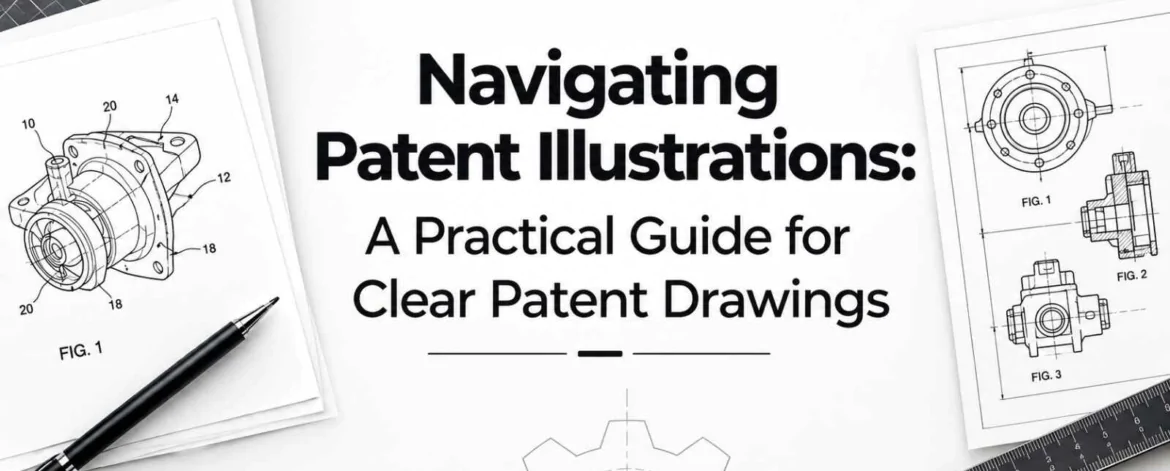
Reference characters also need to be clear and readable. They should not interfere with the drawing and should remain consistent from one figure to another. The regulations specify requirements for numbers, letters, view numbers, and reference characters.
These details may appear minor when looking at one figure on a computer screen, but they become important when the complete drawing set is prepared for filing and publication.
Utility Patent Illustrations
Utility patent applications can cover many different types of inventions, so there is no single drawing style that works for every case.
A mechanical invention may need detailed structural views. An electronic invention may benefit from schematic or block representations. A manufacturing process may be explained through a sequence of diagrams.
For Navigating Patent Illustrations in a utility application, the drawings should be planned alongside the specification and claims. The illustrator should understand which components are identified in the written description and make sure the figures present those components consistently.
Reference numbers should not change between views simply because the angle changes. If the same component appears in Figures 1, 2, and 3, the reader should be able to recognize it through consistent labeling.
Design Patent Illustrations
Design patent drawings require a different approach because the visual appearance of the product is central to the application.
The USPTO permits black-and-white line drawings and, under specified conditions, color drawings or photographs in design applications.
For a design application, the views should work together to show the claimed appearance from the necessary perspectives. Differences between figures can create confusion about the design being presented.
This makes Navigating Patent Illustrations particularly important for design patents. The illustrator must pay close attention to proportions, contours, surface details, perspective, and consistency between views.
Reference Characters and Figure Numbers
Reference characters are one of the easiest areas to get wrong when several figures are prepared.
A component identified with one number in the first figure should normally retain that identification in subsequent figures. Labels should also be positioned so they do not obscure important parts of the illustration.
Figure numbers need to be clear and properly arranged. The USPTO’s drawing standards contain specific requirements for view numbers and reference characters.
A final review should compare the figures with the specification instead of checking each illustration separately. This can reveal numbering differences, missing labels, or features that appear in one figure but are not represented consistently elsewhere.
Common Problems With Patent Illustrations
Some drawing problems are obvious, while others only become noticeable during review.
Weak or uneven lines can make details difficult to reproduce. Crowded labels can cover important portions of a figure. Excessive shading can hide structural information. Inconsistent proportions between views can make the same component appear to be a different shape.
Another problem occurs when a drawing contains details that are not supported by the original disclosure. Patent drawings should not be used to introduce new technical information after filing. The USPTO’s MPEP explains that drawings submitted after filing cannot be used to cure an inadequate original disclosure or supplement the original disclosure for interpreting claim scope.
This is why Navigating Patent Illustrations should involve careful communication between the inventor, patent professional, and illustrator.
Working From Rough Sketches
Inventors often begin with a simple hand sketch. That is not necessarily a problem.
A rough sketch can communicate the basic concept even when it is not suitable for filing. A patent illustrator can use that information as a starting point and develop cleaner figures from it.
The important point is that the finished drawing should represent the invention accurately. The illustrator should not add features merely to make the drawing appear more complete.
Photographs, CAD files, product samples, screenshots, and engineering drawings can also provide useful source material. The appropriate approach depends on the type and complexity of the invention.
Reviewing the Complete Drawing Set
Before filing, the drawings should be reviewed as a complete set.
Check whether every important feature is visible where it needs to be shown. Compare reference numbers across figures. Check figure numbering, line quality, labels, margins, and the relationship between the drawings and the written description.
The USPTO also notes that the specification should include a brief description of each drawing.
A careful review at this stage can identify problems before the application is submitted.
Final Thoughts
Navigating Patent Illustrations becomes much easier when the drawings are treated as part of the patent application rather than as separate artwork.
The best drawings communicate the invention without unnecessary decoration. They show relevant features, use consistent references, provide appropriate views, and follow the applicable USPTO requirements.
For inventors, patent agents, attorneys, and law firms, professional patent drawing support can be useful when converting rough concepts and technical information into a clean drawing set.
The Patent Drawing Services provides support for utility and design patent drawings, helping clients prepare clear technical illustrations for patent applications. A well-planned drawing set can give the written application stronger visual support while reducing avoidable drawing-related problems during filing and review.