When filing a patent application in the United States, patent drawings can play an important role in helping the USPTO examiner understand an invention. While the written description explains how an invention works, drawings provide a visual representation of its structure, components, and operation.
So, how do you prepare Patent Drawings for USPTO Filing correctly? It requires more than creating a simple illustration. Patent drawings must be clear, technically accurate, and prepared according to the applicable USPTO requirements.
For inventors, patent attorneys, and businesses, preparing accurate drawings before filing can help avoid unnecessary corrections and improve the overall clarity of the application.
What Are Patent Drawings for USPTO Filing?
Patent Drawings for USPTO Filing are technical illustrations submitted with a patent application to visually explain an invention. Depending on the type of patent, drawings may show the overall structure, individual components, functional relationships, processes, or design features.
The drawings should work together with the patent specification. They should clearly represent the subject matter described in the application without introducing unsupported features.
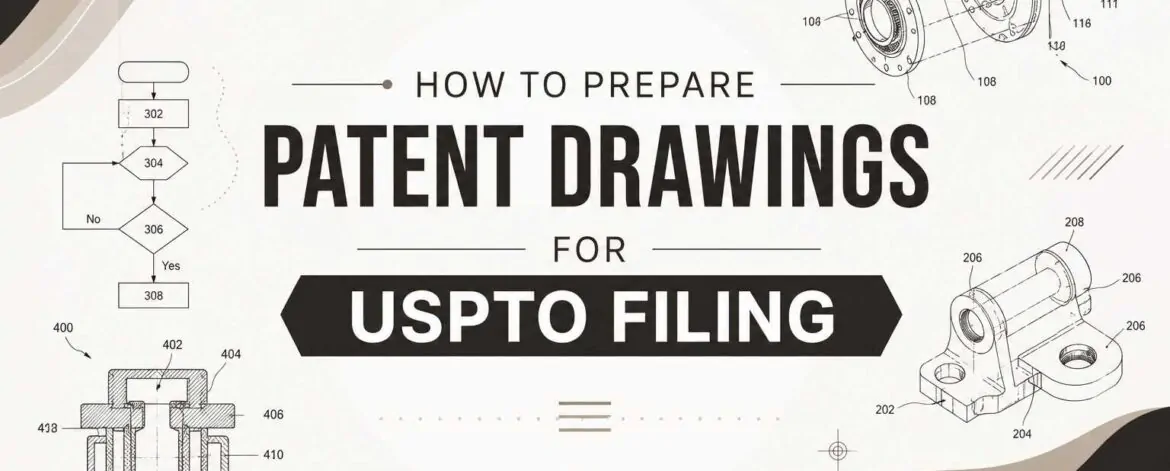
For example, a mechanical invention may require front, rear, side, top, or sectional views. An electrical invention may require circuit diagrams or system illustrations, while certain software-related inventions may use flowcharts or system diagrams.
Why Are Patent Drawings Important for a USPTO Application?
Why are patent drawings so important?
A clear drawing can make complex technical information easier to understand. Instead of relying only on written descriptions, an examiner can use the figures to understand the structure and relationship between different elements of the invention.
Well-prepared Patent Drawings for USPTO Filing can also help maintain consistency between the specification, claims, and figures.
However, patent drawings are not marketing graphics. Their purpose is to technically communicate the invention and support the patent application.
What USPTO Requirements Should You Check Before Preparing Patent Drawings?
Before preparing Patent Drawings for USPTO Filing, you should review the applicable USPTO requirements for your particular application.
Important areas to check include:
- Drawing sheet size and margins
- Line quality and clarity
- Reference numerals
- Figure numbering
- Appropriate views
- Legibility of labels and text
- Consistency between figures
- Proper presentation of technical features
- Appropriate use of sectional views
- Overall drawing quality
Requirements can differ depending on the type of patent application. Utility patent drawings and design patent drawings, for example, have different purposes and presentation considerations.
How Many Views Should a Patent Drawing Have?
There is no single number of views that applies to every invention.
The better question is: How many views are necessary to clearly disclose the invention?
A simple invention may require only a few figures, while a complex invention may need several views to show its different components and relationships.
Common patent drawing views include:
- Perspective view
- Front view
- Rear view
- Left-side view
- Right-side view
- Top view
- Bottom view
- Sectional view
- Exploded view
- Schematic diagram
- Flowchart
Each figure should serve a purpose. Adding unnecessary views can make the application more complicated without providing meaningful information.
How Should Reference Numerals Be Used?
Reference numerals connect the drawings to the written description.
For example, if a component is identified as “100” in the specification, the same component should be identified consistently as “100” throughout the relevant figures.
This becomes particularly important when preparing Patent Drawings for USPTO Filing for complex inventions with many components.
One common mistake is using different numbers for the same component in different figures. Another is using the same reference numeral for unrelated components.
A final comparison between the specification and drawings can help identify these errors before filing.
What Makes a Patent Drawing Clear and Professional?
Clarity is one of the most important characteristics of Patent Drawings for USPTO Filing.
A professional patent drawing should generally have:
- Clean and precise lines
- Consistent line quality
- Clear reference numerals
- Readable labels
- Appropriate spacing
- Properly arranged figures
- Accurate representation of components
- No unnecessary decorative elements
Patent drawings should not look like advertisements or product brochures. Their purpose is to communicate technical information as clearly as possible.
For mechanical inventions, the drawings should clearly show the relationship between components. For electrical inventions, connections and circuit elements should be represented logically. For process-based inventions, flowcharts can help communicate the sequence of operations.
Should Patent Drawings Be Created Before or After the Patent Specification?
Ideally, the drawings and specification should be developed together.
Why?
Because the written description and drawings need to support each other.
If the specification describes a particular component, the corresponding drawing should represent it accurately where appropriate. Similarly, a drawing should not introduce a technical feature that is not properly supported by the application.
Preparing Patent Drawings for USPTO Filing early in the patent preparation process can also help identify missing views or unclear technical relationships.
What Are Common Patent Drawing Mistakes?
Several common mistakes can reduce the quality of patent drawings.
These include:
- Inconsistent reference numerals
- Missing important views
- Incorrect figure numbering
- Poor line quality
- Overcrowded figures
- Unclear labels
- Incorrect margins or formatting
- Unnecessary decorative elements
- Drawings that do not match the specification
- Failure to clearly show important features
These mistakes can often be avoided by reviewing the complete set of drawings before submitting the patent application.
How Can You Prepare Patent Drawings for USPTO Filing Efficiently?
A good preparation process starts with understanding the invention.
First, identify the important structural or functional features that need to be illustrated. Then determine which views will communicate those features most effectively.
Next, create the figures and assign consistent reference numerals. Compare each figure with the patent specification and check whether the drawings accurately represent the disclosed invention.
Finally, conduct a quality review covering formatting, line quality, labels, figure numbers, margins, and consistency.
For complex inventions, professional patent illustrators can make the process more efficient. They can work from inventor sketches, CAD models, photographs, technical documents, or other source material to create formal patent illustrations.
Why Choose The Patent Drawing Services?
Preparing Patent Drawings for USPTO Filing requires technical understanding, precision, and attention to detail.
The Patent Drawing Services provides professional patent illustration support designed to turn technical concepts and source materials into clear patent figures.
Whether you have a basic inventor sketch, CAD file, product photograph, or detailed technical documentation, professional patent illustrators can help develop drawings that clearly communicate the invention.
The goal is to make every figure technically clear, consistent, and suitable for the intended patent application.
Final Thoughts
So, how do you prepare Patent Drawings for USPTO Filing?
Start by understanding the applicable USPTO requirements. Identify the important features of the invention, select the necessary views, use consistent reference numerals, maintain clear line quality, and make sure every figure matches the written description.
Patent drawings are more than simple illustrations. They are an important part of communicating an invention during the patent examination process.
If you need professional Patent Drawings for USPTO Filing, working with experienced patent drawing professionals can help you create accurate, clear, and well-organized figures while reducing common drawing-related issues.
Need professional patent drawings? Contact The Patent Drawing Services to discuss your patent illustration requirements.