USPTO Patent Drawing Rules play an important role in preparing a patent application for filing in the United States. A patent drawing is more than a visual representation of an idea. It helps explain the invention, shows important features, and supports the written description submitted with the application.
When drawings are unclear, inconsistent, or technically incomplete, they can create unnecessary problems during the patent process. Understanding USPTO Patent Drawing Rules can help inventors, businesses, and patent professionals prepare illustrations that clearly communicate the invention.
For complex products and technologies, professionally prepared drawings can make a significant difference. This guide explains the purpose of patent drawing requirements, important preparation considerations, common mistakes, and why professional drawing support can be valuable.
Understanding USPTO Patent Drawing Rules
The purpose of USPTO Patent Drawing Rules is to establish standards for drawings submitted as part of a patent application. These standards help ensure that illustrations are clear, consistent, and suitable for reproduction.
Patent drawings may be required when they are necessary to understand the invention. Even when drawings are not strictly required in every situation, they can provide important visual information that supports the written specification.
Following USPTO Patent Drawing Rules requires attention to both technical details and visual clarity. Every figure should accurately represent the invention and remain consistent with the written description.
A patent examiner should be able to review the figures and understand the relationship between the illustrated components without unnecessary confusion.
Why Patent Drawing Compliance Matters
Patent applicants often focus heavily on claims and written descriptions. However, drawings can also be an important part of the application.
Proper compliance with USPTO Patent Drawing Rules helps create a clean and organized application. A drawing that is difficult to read or does not clearly show important features may need to be corrected.
Drawing-related issues can lead to additional work during the application process. This is why many patent professionals review drawings carefully before filing.
Well-prepared patent illustrations can help:
- Show the invention clearly.
- Identify important components.
- Support the written specification.
- Explain relationships between parts.
- Present different views of the invention.
- Improve the overall organization of the application.
The purpose of patent drawings is technical communication. The illustration should explain the invention rather than function as advertising artwork.
Clear and Consistent Line Work
One of the most important considerations under USPTO Patent Drawing Rules is line clarity. Patent illustrations should remain easy to understand and reproduce.
Lines that are too faint, irregular, or unclear can reduce the quality of a drawing. Consistent technical line work helps separate different features and makes the illustration easier to review.
Complex inventions may contain many components in a limited area. In these situations, careful line placement becomes especially important.
A professional patent illustrator considers the relationship between lines, components, reference characters, and available space. The final illustration should provide sufficient technical detail without becoming visually crowded.
Following USPTO Patent Drawing Rules also means avoiding unnecessary visual effects that do not help explain the invention.
Selecting the Right Patent Drawing Views
The number of figures required depends on the invention. There is no single set of views that is suitable for every patent application.
Under USPTO Patent Drawing Rules, the drawings should provide enough visual information to explain the invention clearly.
Depending on the invention, the drawing package may include:
- Perspective views.
- Front and rear views.
- Top and bottom views.
- Side views.
- Cross-sectional views.
- Exploded views.
- Enlarged views of important features.
A simple product may only require a limited number of illustrations. A complex mechanical or electronic invention may require several figures to explain different components and their relationships.
The key is to select views that provide useful information. Repeating the same visual information across multiple figures without purpose can make the drawing set unnecessarily complicated.
Reference Numbers and Figure Consistency
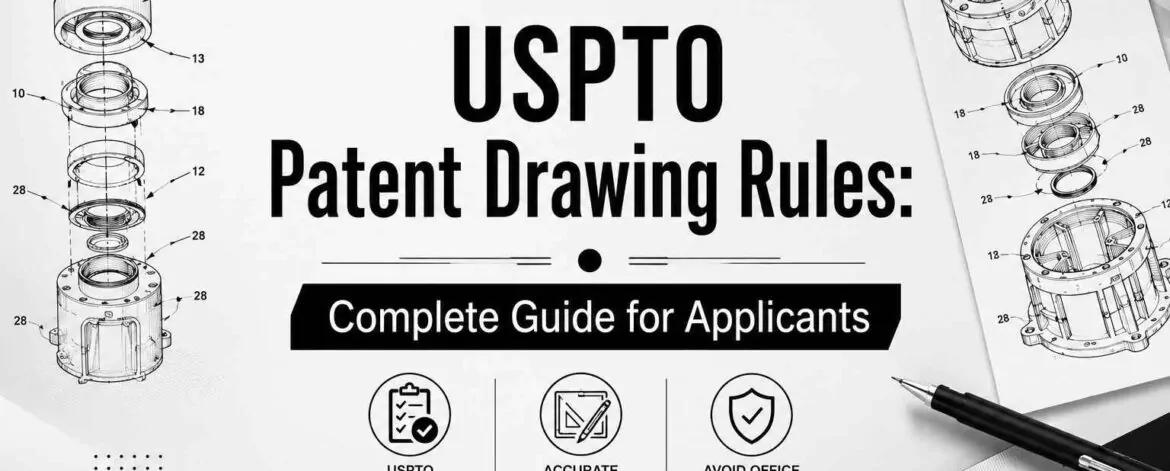
Reference characters help connect the patent drawings with the written specification. A number can identify a specific component, feature, or element of the invention.
Consistency is essential when following USPTO Patent Drawing Rules. If the same component appears in several figures, its identifying reference character should be used consistently.
For example, if a housing is identified by one reference number in the first figure, changing that number in another figure can create confusion.
Reference numbers should also correspond correctly with the written description. Before filing, applicants should compare every figure with the specification to confirm that the references match.
This review process can identify missing numbers, duplicate numbers, and incorrectly labelled features.
Reference Numbers and Figure Consistency
Reference characters help connect the patent drawings with the written specification. A number can identify a specific component, feature, or element of the invention.
Consistency is essential when following USPTO Patent Drawing Rules. If the same component appears in several figures, its identifying reference character should be used consistently.
For example, if a housing is identified by one reference number in the first figure, changing that number in another figure can create confusion.
Reference numbers should also correspond correctly with the written description. Before filing, applicants should compare every figure with the specification to confirm that the references match.
This review process can identify missing numbers, duplicate numbers, and incorrectly labelled features.
Proper Arrangement of Patent Figures
The arrangement of figures can affect how easily an invention is understood.
According to USPTO Patent Drawing Rules, patent illustrations should be organized in a clear and logical manner. Each figure should have enough space for the illustrated features and reference characters.
Overcrowding can make a drawing difficult to read. On the other hand, poorly arranged figures can leave important areas too small.
Patent illustrators carefully balance detail and spacing. Related figures should maintain a consistent orientation whenever possible.
A logical arrangement also helps patent professionals review the application before submission.
Shading and Surface Features
Shading can help communicate the three-dimensional characteristics of an object. It may be useful for showing curved surfaces, depth, contours, and other physical features.
However, shading should always serve a technical purpose.
When preparing drawings under USPTO Patent Drawing Rules, excessive shading can make an illustration difficult to reproduce clearly. Inconsistent shading may also create uncertainty about whether differences between figures represent actual differences in the invention.
A consistent drawing approach helps maintain clarity throughout the application.
The appropriate use of shading may depend on the type of patent application and the nature of the invention.
Utility and Design Patent Drawing Considerations
Different patent applications require different approaches to illustration.
Utility patent drawings generally focus on showing the structural and functional aspects of an invention. The figures may show individual components, internal structures, processes, or the relationship between different parts.
Design patent drawings are particularly important because they visually show the design being claimed.
For both application types, USPTO Patent Drawing Rules should be considered during the preparation process. The type of invention and the type of patent application can affect the number of views and the level of detail needed.
A professional illustrator can help determine how the invention should be visually presented based on the information provided by the inventor or patent professional.
Common Problems in Patent Drawings
Many issues arise when drawings are prepared without a detailed review.
Common problems include:
- Missing or unclear views.
- Inconsistent reference characters.
- Figures that do not match the written specification.
- Poor line quality.
- Overcrowded components.
- Incorrect orientation.
- Unclear sectional views.
- Inconsistent visual representation between figures.
These mistakes can often be avoided by reviewing the drawings against the application before filing.
Understanding USPTO Patent Drawing Rules before beginning the illustration process can save time and reduce the need for later corrections.
The Importance of Professional Patent Illustrators
Preparing patent drawings requires a combination of technical understanding and illustration skills.
An inventor may understand the product perfectly but may not have experience preparing formal technical illustrations. Similarly, a general graphic designer may have strong visual skills but may not understand patent drawing requirements.
Professional patent illustrators focus on converting technical information into clear patent-ready figures.
The Patent Drawing Services helps inventors, businesses, and patent professionals prepare high-quality patent illustrations. Our team understands the importance of accuracy, consistency, and clear visual communication.
By working with experienced professionals, applicants can spend more time focusing on their invention and application strategy while the drawing process is handled with attention to detail.
A Better Approach to Patent Drawing Preparation
A structured process can improve the quality of patent drawings.
The first step is understanding the invention and identifying the features that need to be illustrated. Next, the appropriate views should be selected.
After the figures are prepared, each illustration should be checked against the written description. Reference characters should be reviewed, and the relationship between different figures should be confirmed.
This approach supports compliance with USPTO Patent Drawing Rules while improving the overall clarity of the application.
Professional review is particularly valuable for inventions with complicated structures, multiple components, or detailed internal features.