A good utility patent drawing does more than show what an invention looks like. It helps the reader understand how the invention is constructed, how its components relate to one another, and which features are important to the claimed invention. For that reason, preparing patent drawings requires technical understanding as well as careful attention to patent-office standards.
The Guidelines for Creating Utility Patent Drawings are especially important when an invention contains multiple components, internal mechanisms, electrical connections, moving parts, or complex assemblies. A drawing that looks acceptable at first glance can still create problems if important features are missing, reference numbers are inconsistent, or the figures are difficult to understand.
For inventors preparing a U.S. application, the USPTO explains that drawings are required when they are necessary to understand the subject matter of the invention. The drawings must also follow specific standards concerning presentation, margins, numbering, lines, views, and other details.
Start With the Invention, Not the Drawing
One of the biggest mistakes in patent drawing preparation is starting the artwork too early.
Before creating any figure, the drafter should understand the invention. This means reviewing the inventor’s sketches, CAD files, photographs, technical descriptions, product samples, or other available information. The objective is to identify the important components and understand how they interact.
The Guidelines for Creating Utility Patent Drawings should therefore begin with a technical review. A professional drafter should ask: What needs to be shown? Which components are essential? What relationship between the parts needs to be understood? Is an internal feature important to the invention?
Answering these questions first makes the later drawing process much more efficient.
Choose Views That Explain the Invention
There is no universal number of figures that works for every utility patent. Some inventions may be adequately explained with a few views, while complicated devices may require many figures.
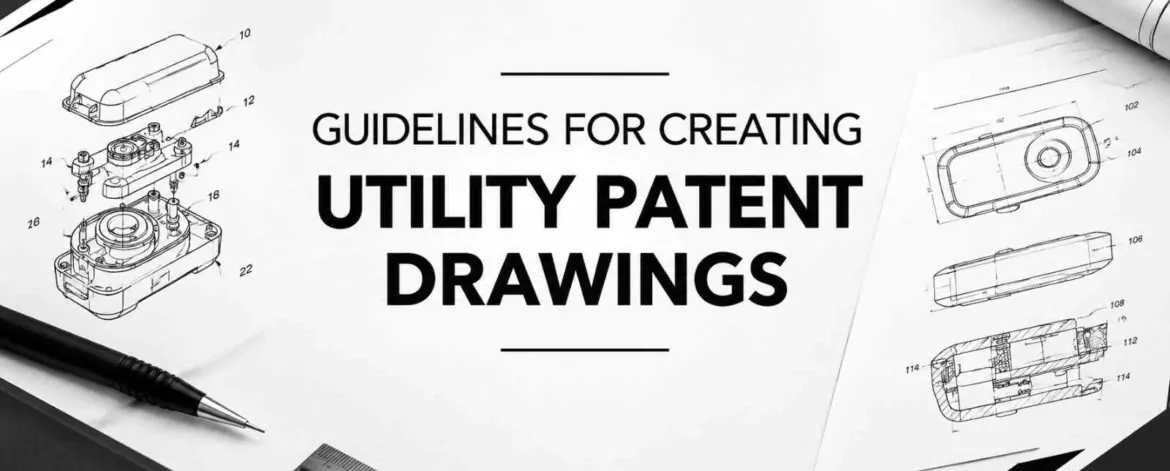
A typical drawing set may include a perspective view, front or side views, a sectional view, an exploded view, a detailed view, or a diagram showing a functional relationship.
The important point is that every figure should have a purpose. Adding unnecessary figures simply to make the application look more complete does not improve the disclosure.
The Guidelines for Creating Utility Patent Drawings should focus on selecting views that make the invention easier to understand. If an important component is hidden inside a housing, for example, an external perspective view alone may not be enough. A sectional or enlarged detail view may provide the missing information.
Keep Reference Numbers Consistent
Reference numerals are one of the simplest parts of patent drawings to overlook, yet they are extremely important.
A component identified as 100 in one figure should normally remain 100 wherever that same component appears. Changing the number between figures can create unnecessary confusion for the examiner and anyone reviewing the application.
The same principle applies to the specification. Reference signs appearing in the drawings should correspond with the written description.
WIPO’s PCT drawing rules similarly emphasize that the same features should be identified by the same reference signs throughout an international application.
Use Sectional Views When Internal Features Matter
Many inventions cannot be properly explained from the outside.
Consider a mechanical assembly containing internal gears, passages, chambers, fasteners, or electronic components. A sectional view can reveal these features without requiring the reader to interpret a complicated written explanation.
Cross-sectional views should be prepared carefully. Hatching should distinguish cut surfaces without interfering with reference numbers or important lines. WIPO’s current PCT requirements also specify the use of appropriate hatching for cross-sections and emphasize maintaining clear reference signs.
A useful rule within the Guidelines for Creating Utility Patent Drawings is simple: if an important feature cannot be understood from an ordinary view, consider whether a section or enlarged detail is necessary.
Use Exploded Views to Show Relationships
Exploded views can be particularly helpful for inventions containing multiple parts that fit together.
An exploded figure can show the relationship between components, the order of assembly, and the location of individual parts. It is especially useful when several components overlap in an assembled view.
However, an exploded view should remain technically accurate. Components should not be separated in a way that creates a misleading impression of the invention.
WIPO’s current applicant guidance recognizes exploded views, sections, cross-sections, perspective views, and enlarged details as appropriate forms of patent drawings.
Avoid Unnecessary Text Inside Figures
Patent drawings should communicate through technical illustration and reference signs wherever possible.
Too much text can make a figure crowded and difficult to reproduce. Under PCT Rule 11.11, text in drawings is generally limited to words that are absolutely indispensable, with certain practical exceptions for diagrams and flowcharts.
For a U.S. application, the applicable requirements should always be checked separately because filing standards can differ between jurisdictions.
Keeping figures visually clean is therefore another important part of the Guidelines for Creating Utility Patent Drawings.
Pay Attention to Sheet Layout and Margins
Even an accurate technical illustration can require correction if it is poorly positioned on the drawing sheet.
For U.S. utility applications, the USPTO specifies minimum margins for commonly used 8.5 × 11-inch and A4 drawing sheets. The USPTO also provides requirements concerning the usable drawing area and presentation of figures.
Figures should be arranged logically, separated clearly, and large enough for their technical details to remain readable.
For PCT applications, WIPO specifies A4 drawing sheets and provides its own margin and presentation requirements.
This difference illustrates why drawings intended for international filing should not simply be prepared from assumptions based on one country’s rules.
Check the Drawing Against the Written Description
A drawing should never be reviewed separately from the patent specification.
After completing the figures, compare them with the written description and claims. Check the component names, reference numbers, positions, connections, and technical relationships.
If the specification refers to a component that is shown as 120, the drawing should not accidentally label it 102. Similarly, an important relationship described in the application should not be represented incorrectly in the figure.
This final comparison is one of the most valuable Guidelines for Creating Utility Patent Drawings because many avoidable mistakes can be identified before filing.
Consider U.S. and International Filing Requirements
Inventors who may eventually pursue protection outside the United States should think about international requirements early.
The USPTO has its own drawing standards, while PCT applications follow WIPO’s requirements. European patent applications also have their own formal requirements. Preparing drawings with international filing considerations in mind can make later prosecution more efficient, although the applicable requirements should always be reviewed for the specific filing.
Under the PCT, drawings are required when they are necessary for understanding the invention, and they must meet specific physical and presentation requirements.
Common Problems to Catch Before Filing
A final quality review should look for more than obvious artistic mistakes.
Check whether:
- Important components are clearly visible.
- The selected views actually explain the invention.
- Reference numbers are consistent.
- Labels are readable and properly positioned.
- Sectional views use appropriate hatching.
- Lines are clear and reproducible.
- Figures are not unnecessarily crowded.
- Sheet margins and layout are appropriate.
- The drawings match the specification.
- No important technical feature has been accidentally omitted.
These checks can make the difference between a clean professional drawing set and one that requires avoidable corrections.
Professional Utility Patent Drawing Support
Inventors often provide a hand sketch, CAD model, photograph, or rough engineering drawing as the starting point. These materials can contain everything a patent drafter needs, but they usually require technical interpretation and refinement.
At The Patent Drawing Services, utility patent drawings are prepared for inventors, patent attorneys, patent agents, law firms, and businesses. The service covers technical illustrations such as perspective views, sectional drawings, exploded views, detailed views, and complex assemblies.
The goal is not simply to make the invention look professional. The goal is to create figures that communicate the invention accurately and clearly while taking applicable patent-office requirements into account.
Final Thoughts
Creating effective utility patent drawings requires more than converting a sketch into a clean illustration. The drafter must understand the invention, select useful views, maintain consistent reference numbers, control line quality, present internal features correctly, and ensure that the figures work together with the written disclosure.
The Guidelines for Creating Utility Patent Drawings provide a practical framework for approaching this process from the first technical review through the final quality check.
For U.S. filings, applicants should always verify the current USPTO requirements before submission. For international applications, WIPO’s PCT requirements and the rules of the relevant national or regional office should also be considered. Patent drawing standards can affect how an invention is communicated, so careful preparation is worth the effort.
A well-prepared drawing set makes complex technical information easier to understand and gives the patent application a clearer visual foundation. For inventors working with complicated products or systems, professional utility patent drawing support can help turn rough technical information into precise, filing-ready figures.