Introduction: The Evolving Landscape of Visual IP Disclosure
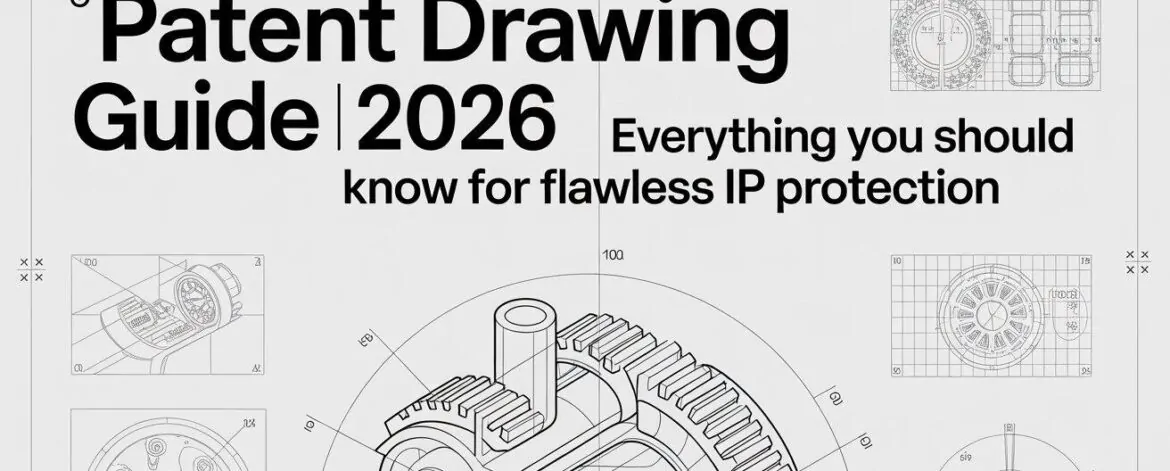
As we move through 2026, the world of intellectual property continues to accelerate, with innovations becoming increasingly complex and global protection more crucial than ever. At the heart of nearly every successful patent application lies a fundamental, yet often underestimated, component: the patent drawings. These drawings have evolved from simple illustrations to sophisticated technical documents that can determine the fate of your intellectual property rights. This comprehensive Patent drawing guide 2026 provides everything inventors, startups, law firms, and corporate IP departments need to navigate the current standards, anticipate changes, and ensure their visual disclosures meet the exacting requirements of patent offices worldwide.
At The Patent Drawing Services, we’ve been at the forefront of this evolution, helping thousands of clients secure their innovations with precision-crafted drawings. While we specialize in comprehensive Utility Patent Drawings Services and Design Patent Drawings Services, plus essential Trademark Drawing Services, we recognize that success begins with education. This Patent drawing guide 2026 is designed to demystify the process, highlight critical updates, and provide actionable insights for protecting your inventions in today’s competitive landscape.
Why Patent Drawings Matter More Than Ever in 2026
The visual component of a patent application has never been more critical. Several converging trends in 2026 have elevated the importance of professional patent drawings:
- Increased Examiner Scrutiny: Patent offices worldwide are implementing more rigorous quality checks. The United States Patent and Trademark Office (USPTO) has enhanced its automated drawing review systems, flagging non-compliance issues more quickly than ever before. A flawed drawing can trigger immediate rejection, delaying protection by months.
- Rise of AI-Powered Prior Art Searches: Examination increasingly utilizes artificial intelligence to scan global databases. Clear, well-structured drawings help AI systems properly categorize and understand your invention, potentially leading to more accurate prior art identification and stronger patents.
- Global Harmonization Pressures: As the World Intellectual Property Organization (WIPO) pushes for greater international consistency, understanding the nuanced differences between the European Patent Office (EPO), USPTO, and other major offices remains essential for cost-effective global protection.
- Litigation Preparedness: In an era of increased patent disputes, drawings serve as crucial evidence. Ambiguous or inconsistent drawings can weaken enforcement or provide opportunities for competitors to design around your protection.
Understanding Different Patent Drawing Types in 2026
1. Utility Patent Drawings
Utility drawings illustrate the functional aspects of an invention. In 2026, trends show increased acceptance of hybrid illustration styles that combine traditional technical drawing with enhanced visualization techniques.
Key 2026 Considerations:
- Flowcharts & Diagrams: For software, business methods, and AI-related inventions, dynamic process diagrams have become increasingly sophisticated. The USPTO now accepts certain interactive elements in digital submissions.
- 3D Modeling Integration: While traditional line drawings remain mandatory, supplemental 3D models in STL or other formats are sometimes submitted as auxiliary materials, particularly for complex mechanical inventions.
- Biotech & Chemical Illustrations: Enhanced standards for genetic sequences, chemical compounds, and biological processes require specialized drafting expertise.
Our Utility Patent Drawings Services have evolved with these trends, ensuring your functional innovations are presented with both technical precision and modern clarity.
2. Design Patent Drawings
Design patents protect ornamental appearance, making the drawings literally the legal definition of what’s protected. 2026 has brought subtle but important shifts in how these drawings are interpreted and required.
Key 2026 Considerations:
- GUI & Virtual Designs: With the explosion of augmented reality (AR), virtual reality (VR), and sophisticated user interfaces, drawings must clearly show transient states, animations (through multiple static views), and virtual elements in their environment.
- Color & Texture Claims: While traditionally limited, certain jurisdictions are becoming more accepting of color claims when they form an integral part of the design. Strategic use of color views alongside traditional line drawings has become a sophisticated tactic.
- Broken Line Conventions: The strategic use of broken lines to indicate unclaimed portions has become more nuanced, with specific rules about environmental context versus unclaimed portions of the article itself.
Our Design Patent Drawings Services stay current with these evolving standards, protecting your product’s aesthetic value in any jurisdiction.
3. Trademark Drawings
Though not patent drawings per se, trademark drawings complete the IP protection picture. In 2026, the lines between design patents and trade dress protection continue to blur, making coordinated strategy essential.
2026 Trademark Drawing Insights:
- Digital-First Representations: With brands existing primarily in digital spaces, drawings must accurately represent how marks appear on screens, apps, and digital interfaces.
- Motion Mark Considerations: For trademarks with motion elements, a series of still drawings showing key frames has become standard practice at leading offices.
Our Trademark Drawing Services ensure your brand identity receives the same rigorous attention to detail as your patented innovations.
Essential Technical Specifications: The 2026 Standards
A. USPTO Requirements (Updated for 2026)
The USPTO maintains strict formal requirements, with some important updates:
- Sheet Size & Margins: Still primarily letter size (8.5 x 11 inches) or A4, with specific margins (top: 1 inch, sides & bottom: variable but consistent).
- Digital Submission Standards: PDF specifications have been updated. Minimum 300 DPI resolution is now strictly enforced, with improved automated checks for compliance.
- Color Drawing Petitions: While still requiring a petition, the process for color drawings has been streamlined slightly for certain technology categories, particularly in life sciences and graphical interfaces.
- Numbering & Lettering: Reference numerals must be at least 0.32 cm (1/8 inch) high. The office has increased scrutiny on consistency across all views.
B. International Considerations (EPO, WIPO, and Beyond)
Filing internationally requires understanding varying requirements:
- EPO Standards: Generally more flexible regarding photographs and color, but with specific requirements for view labeling and sheet numbering that differ from USPTO practice.
- WIPO PCT Filings: As the gateway to international protection, PCT drawings must balance multiple jurisdictions’ requirements. The trend toward accepting both drawings and photographs continues.
- Asian Patent Offices: Japan (JPO), China (CNIPA), and Korea (KIPO) have unique formatting preferences that should be considered early in the process for cost-effective global protection.
The Step-by-Step Process: From Concept to Complaint Drawing in 2026
Following this Patent drawing guide 2026 process will maximize your success:
Step 1: Invention Analysis & Strategy
Before drafting begins, analyze which elements need protection. Consider:
- What are the novel features?
- Should environmental context be shown or excluded?
- Will utility and design protection both be sought?
- What jurisdictions are targeted?
Step 2: Gathering Reference Materials
Provide your drafter with:
- Sketches, photographs, or prototypes
- CAD files (if available)
- Prior art references
- Written description of the invention
Step 3: View Selection & Planning
Professional drafters plan the view set to:
- Fully disclose the invention
- Support the broadest possible claims
- Create examiner-friendly comprehension
- Anticipate potential amendments during prosecution
Step 4: Drafting & Refinement
Using specialized software, drafters create compliant drawings with:
- Proper line weights and types
- Consistent reference numbering
- Appropriate shading and texture indications
- Clear labeling and legends
Step 5: Quality Assurance & Compliance Check
Every drawing set should undergo rigorous review against:
- Target patent office formal requirements
- Internal consistency checks
- Claim support verification
- Global adaptability assessment
Step 6: Finalization & File Preparation
Delivery should include:
- Print-ready PDFs meeting office specifications
- Editable source files for future amendments
- Any required transmittal forms or instructions
Common Pitfalls to Avoid in 2026 (Based on Recent Rejection Data)
Our analysis of 2025-2026 office actions reveals these persistent issues:
- Inconsistent Reference Numerals: Still the #1 cause of drawing objections. Every distinct part must have a unique number used consistently across all views.
- Insufficient Views for 3D Objects: Particularly for design patents, missing standard orthographic views (top, bottom, left, right) continues to trigger rejections.
- Improper Shading Techniques: Using photographic shading rather than approved line or stipple shading remains problematic at the USPTO.
- Digital File Format Issues: Submitting low-resolution scans or compressed files that don’t meet updated digital submission standards.
- Global Incompatibility: Creating drawings that work for one office but require expensive modification for others in the patent family.
The Future of Patent Drawings: Beyond 2026
While this Patent drawing guide 2026 focuses on current standards, looking ahead reveals exciting developments:
- AI-Assisted Drafting: Emerging tools can help generate preliminary views from 3D models, though human expertise remains essential for legal compliance.
- Interactive & Animated Submissions: Some offices are experimenting with accepting limited interactive elements for particularly complex inventions.
- Blockchain Verification: Timestamping and verifying drawing creation dates using blockchain technology may become more prevalent.
- Enhanced Virtual Reality Review: Examiners may eventually review 3D models in virtual environments for certain complex mechanical inventions.
Conclusion: Your 2026 Blueprint for Success
This Patent drawing guide 2026 underscores a fundamental truth: in an increasingly competitive and global IP landscape, professional patent drawings are not an expense but an investment. They are the visual foundation upon which your patent rights are built, examined, and ultimately enforced.
As standards evolve and examination becomes more sophisticated, partnering with experts who dedicate themselves to these specialized requirements provides peace of mind and strategic advantage. Flawless drawings prevent costly delays, support stronger claims, and create assets that stand up to global scrutiny and potential litigation.
At The Patent Drawing Services, we combine decades of expertise with continuous adaptation to the latest standards. Whether you need Utility Patent Drawings for a complex mechanical invention, Design Patent Drawings for a cutting-edge consumer product, or Trademark Drawings to protect your brand identity, we provide the precision and compliance your intellectual property deserves.
Don’t let inadequate drawings undermine your innovation. Use this Patent drawing guide 2026 as your roadmap to secure, enforceable protection.
Ready to transform your invention into professionally protected intellectual property? Contact The Patent Drawing Services today for a consultation or instant quote. Let us handle the drawings while you focus on innovation.
Frequently Asked Questions (FAQs)
Q1: Can I use the same drawings for USPTO and international filings in 2026?
Often, but not always. While core illustrations can typically be reused, formatting adjustments are frequently necessary. The paper size, margin requirements, view labeling conventions, and acceptable media (drawings vs. photographs) vary between offices. A professional service will create a “master set” designed for easy adaptation to multiple jurisdictions.
Q2: How has artificial intelligence impacted patent drawing requirements in 2026?
AI has impacted the examination process more than the drawing requirements themselves. Examiners use AI tools for prior art search and analysis, making clear, well-structured drawings that accurately represent the invention more important than ever. Ambiguous drawings can confuse AI systems, potentially leading to incorrect prior art citations or misunderstandings of the invention’s novelty.
Q3: What’s the biggest change in design patent drawings since 2025?
The most significant evolution continues to be in protecting digital and virtual designs. There’s increased clarity (but still some variation between offices) on how to represent graphical user interfaces, virtual items in AR/VR environments, and designs that change state. Multiple static views showing key states have become the standard approach for dynamic designs.
Q4: Are 3D models or CAD files acceptable as patent drawings yet?
Generally, no. Traditional 2D line drawings remain the required standard for formal submissions at major offices including the USPTO and EPO. However, some offices may accept 3D model files as supplementary materials. CAD files are invaluable as source material for creating compliant 2D drawings but are rarely acceptable as-is due to formatting and disclosure issues.
Q5: How long do professional patent drawings typically take in 2026?
Turnaround times have compressed with improved digital workflows. For a typical utility application, 3-5 business days is standard. Design patents often take 2-4 days, while trademark drawings can frequently be completed in 1-2 days. Most professional services, including ours, offer expedited options (24-48 hours) for urgent filings.