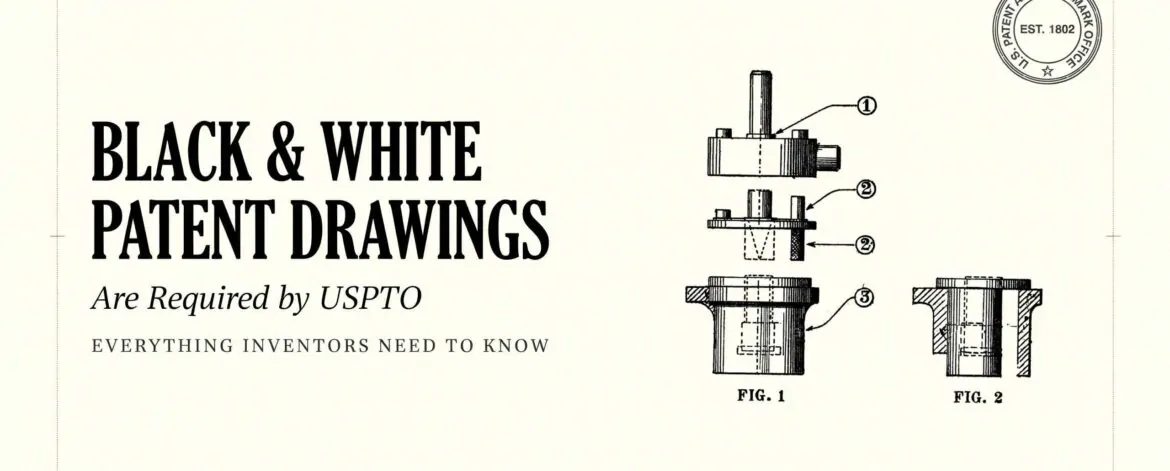
When preparing a patent application, inventors often concentrate on claims, descriptions, and technical details while giving less attention to the drawings. However, patent illustrations are an important part of the application. Black and White Patent Drawings are the standard required for most USPTO patent applications because they provide clear, consistent, and reproducible representations of an invention.
The United States Patent and Trademark Office (USPTO) follows specific requirements for patent drawings, including line quality, margins, numbering, reference characters, and visual clarity. Drawings that fail to meet these requirements can lead to objections, corrections, additional costs, and delays during prosecution.
Understanding the purpose and requirements of Black and White Patent Drawings can help inventors prepare stronger applications and avoid common filing problems.
What Are Black and White Patent Drawings?
Black and White Patent Drawings are technical illustrations created primarily with solid black lines on a white background. They are designed to communicate the structure, operation, and important features of an invention without unnecessary artistic effects.
Unlike marketing images or product illustrations, patent drawings have a legal and technical purpose. Every line, label, number, and view should contribute to explaining the invention.
They are commonly used for inventions involving:
- Mechanical devices
- Electronic systems
- Medical equipment
- Manufacturing machinery
- Consumer products
- Industrial equipment
- Computer-related inventions
- Complex assemblies and systems
Well-prepared Black and White Patent Drawings make it easier for patent examiners to understand the invention and compare the disclosure with the claims.
Why Does the USPTO Require Black and White Drawings?
The USPTO generally requires patent drawings to be in black and white under its drawing rules. The requirement helps maintain consistency and ensures that submitted figures can be clearly reproduced in patent records and publications.
There are several practical reasons for this standard.
Clear Reproduction
Black lines against a white background provide strong contrast. This makes figures easier to reproduce through scanning, printing, copying, and digital publication.
Consistent Examination
Patent examiners review applications from many different technical fields. A consistent drawing format allows figures to be evaluated without distractions caused by colors, decorative effects, or inconsistent presentation.
Better Technical Communication
Color is not normally necessary to explain the structure of an invention. Clean Black and White Patent Drawings allow inventors to emphasize components, relationships, connections, and functional features through line work and reference characters.
Long-Term Recordkeeping
Patent applications become part of the permanent intellectual property record. Clear black-and-white figures are suitable for long-term storage and reproduction.
Key USPTO Requirements for Black and White Patent Drawings
Preparing compliant Black and White Patent Drawings requires attention to several technical details.
1. Clean and Uniform Lines
Lines should be sufficiently dark and consistent to reproduce clearly. Extremely thin, broken, or uneven lines can make important features difficult to understand.
2. Appropriate Margins
Patent drawing sheets must follow USPTO requirements for margins and page presentation. Incorrect margins can result in a formal drawing objection.
3. Correct Figure Numbers
Each figure should be numbered consistently, and the figures should correspond with the description in the patent specification.
4. Reference Characters
Components shown in the drawings should use reference characters that correspond with the written description. Missing, duplicated, or inconsistent reference numbers can create confusion.
5. Appropriate Views
The drawings should disclose the relevant features of the invention. Depending on the technology, this may include perspective, front, rear, side, top, bottom, sectional, exploded, or schematic views.
6. Clear Backgrounds
The drawing area should remain clean and free from unnecessary backgrounds, decorative elements, textures, or visual effects.
Are Color Patent Drawings Allowed by the USPTO?
Color drawings are possible, but they are not the normal standard. Under USPTO rules, color may be permitted when it is necessary to understand the claimed subject matter and cannot be adequately represented using black-and-white drawings.
An applicant seeking to use color generally needs to follow the USPTO’s requirements for submitting a petition for acceptance of color drawings and provide the required explanation.
For most inventions, Black and White Patent Drawings remain the practical and standard choice because they clearly communicate technical information without requiring color.
Common Mistakes Inventors Should Avoid
Many drawing objections result from avoidable preparation errors. Common problems include:
- Submitting low-resolution images
- Using inconsistent line weights
- Adding unnecessary shading
- Incorrect figure numbering
- Missing reference characters
- Using unclear labels
- Providing incomplete views
- Ignoring required margins
- Including decorative backgrounds
- Using product photographs when technical drawings are needed
A simple sketch may help an inventor communicate an idea to an illustrator, but it may not be suitable for filing. Professional Black and White Patent Drawings should be prepared specifically for patent requirements.
Black and White Patent Drawings for Utility Patents
Utility patent applications frequently require detailed technical illustrations because the invention may involve multiple components and functional relationships.
Depending on the invention, drawings can include:
- Perspective views
- Cross-sectional views
- Exploded views
- Assembly diagrams
- Flowcharts
- Circuit diagrams
- System architecture diagrams
- Enlarged detail views
The purpose of these Black and White Patent Drawings is to provide visual support for the written disclosure while showing the features necessary to understand the invention.
Black and White Patent Drawings for Design Patents
Design patent applications are different because they primarily protect the ornamental appearance of a product. The drawings therefore play an especially important role in defining what is being claimed.
Accurate views can show the overall appearance of the design from different perspectives. Missing or inconsistent features can affect how the scope of the design is understood.
Because of this, professional Black and White Patent Drawings can be valuable when preparing design patent figures that need to accurately represent the claimed appearance.
Why Work With Professional Patent Illustrators?
Creating compliant patent drawings requires more than simply converting a sketch into a digital image. A professional illustrator understands patent drawing conventions and can transform technical information into precise figures.
Professional Black and White Patent Drawings can provide several advantages:
- Better technical clarity
- Consistent line quality
- Correct reference characters
- Proper figure organization
- Cleaner presentation
- Reduced risk of formal drawing objections
- Better consistency between drawings and specification
Professional preparation can also save inventors time by reducing the need for repeated corrections before filing.
How The Patent Drawing Service Can Help
At The Patent Drawing Service, patent illustrations are prepared with attention to technical accuracy and patent office requirements. Our team provides professional Utility Patent Drawings, Design Patent Drawings, and Trademark Drawings for clients seeking clear and reliable IP illustrations.
We understand that every invention is different. Whether the application involves a mechanical product, electronic device, medical technology, software-related system, or industrial invention, the drawings should accurately communicate the disclosed subject matter.
Our Black and White Patent Drawings are prepared to support filing requirements and maintain consistency between the figures and the patent specification. We also support international patent illustration requirements involving offices and systems such as the USPTO, EPO, and WIPO.
Final Thoughts
Black and White Patent Drawings are more than simple illustrations. They are an important part of communicating an invention clearly within a patent application. Following USPTO drawing requirements can help reduce avoidable objections and ensure that the application’s visual disclosure is clear and professionally presented.
Inventors should pay close attention to line quality, margins, figure numbering, reference characters, appropriate views, and overall technical accuracy. When the invention is complex, working with experienced patent illustrators can make the preparation process easier and more reliable.
If you are preparing a new patent application or updating existing figures, professional Black and White Patent Drawings can provide the clarity and consistency needed to support your patent filing. The Patent Drawing Service offers accurate patent illustrations tailored to your invention and designed to meet professional patent drawing standards.