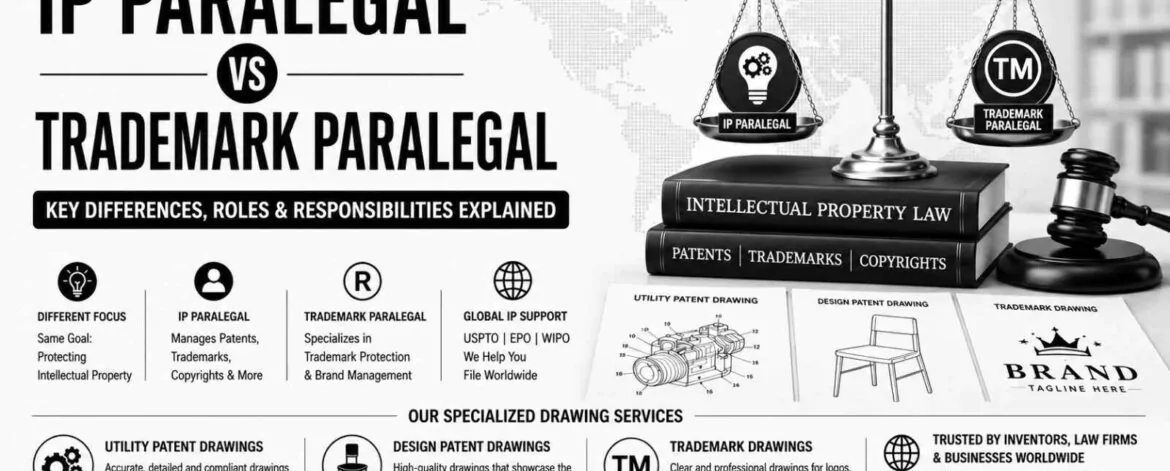
Intellectual property (IP) is one of the most valuable assets for businesses, startups, inventors, and global brands. Protecting patents, trademarks, copyrights, and designs requires more than experienced attorneys—it also depends on skilled legal professionals working behind the scenes. One of the most common questions businesses ask is about the IP Paralegal Vs Trademark Paralegal role.
Although these two positions share several responsibilities, they are not the same. Understanding the difference between IP Paralegal Vs Trademark Paralegal helps law firms, corporations, and inventors choose the right professional for their intellectual property needs.
In this guide, we’ll explain every aspect of IP Paralegal Vs Trademark Paralegal, their responsibilities, required skills, career opportunities, and why professional patent drawings remain essential throughout the patent application process.
What Is an IP Paralegal?
An Intellectual Property (IP) Paralegal supports attorneys handling every type of intellectual property matter. Their work includes patents, trademarks, copyrights, industrial designs, licensing agreements, and intellectual property portfolio management.
An IP paralegal works closely with inventors, patent attorneys, trademark attorneys, corporations, research organizations, and government intellectual property offices.
Typical responsibilities include:
- Preparing patent filing documents
- Managing trademark applications
- Handling copyright registrations
- Monitoring IP deadlines
- Maintaining IP portfolios
- Preparing assignments and ownership documents
- Filing documents before various intellectual property offices
- Coordinating with inventors and attorneys
- Organizing patent prosecution records
Because intellectual property covers several legal areas, IP paralegals require broader knowledge than specialists focused only on trademarks.
What Is a Trademark Paralegal?
Trademark law is the exclusive area of expertise for a trademark paralegal. Their primary responsibility is protecting brand names, logos, slogans, symbols, and service marks.
Instead of working across all intellectual property matters, trademark paralegals concentrate on trademark prosecution, maintenance, renewals, and enforcement.
Daily responsibilities often include:
- Preparing trademark applications
- Conducting preliminary trademark searches
- Managing office action responses
- Filing Statements of Use
- Monitoring renewal deadlines
- Recording ownership changes
- Tracking trademark oppositions
- Managing trademark portfolios
- Coordinating international trademark filings
Their expertise lies entirely within trademark law rather than patents or copyrights.
IP Paralegal Vs Trademark Paralegal: Major Differences
Understanding IP Paralegal Vs Trademark Paralegal becomes easier when comparing their responsibilities.
Feature | IP Paralegal | Trademark Paralegal |
Scope of Work | Patents, trademarks, copyrights, designs | Only trademarks |
Patent Knowledge | Extensive | Minimal |
Trademark Filing | Yes | Yes (Primary Focus) |
Copyright Work | Yes | Usually No |
Licensing Agreements | Yes | Occasionally |
Patent Prosecution | Yes | No |
Trademark Monitoring | Yes | Extensive |
Design Applications | Yes | Rare |
This comparison clearly shows why IP Paralegal Vs Trademark Paralegal is an important distinction for organizations managing different types of intellectual property.
Educational Background
Both professionals generally have:
- Bachelor’s degree
- Paralegal certification (preferred)
- Legal documentation experience
- Strong communication skills
- Excellent organizational abilities
However, IP paralegals often require additional technical understanding because patent applications involve engineering, science, biotechnology, software, pharmaceuticals, and mechanical inventions.
Trademark paralegals usually focus more on branding, marketing, and intellectual property rights related to business identity.
Patent Responsibilities of an IP Paralegal
Patent work is a significant distinction between IP paralegals vs trademark paralegal.
An IP paralegal regularly assists with:
- Utility patent applications
- Design patent applications
- Patent prosecution
- Patent assignments
- Information Disclosure Statements (IDS)
- Patent maintenance fees
- Patent portfolio management
- Patent filing coordination
- International patent filings
They also communicate with patent illustrators to ensure patent drawings comply with patent office standards.
Trademark Responsibilities of a Trademark Paralegal
Trademark paralegals spend most of their time handling:
- Trademark applications
- Office action responses
- Trademark renewals
- Trademark assignments
- Monitoring deadlines
- Trademark opposition proceedings
- Madrid Protocol filings
- Brand portfolio management
- Trademark watch services
Because trademarks require ongoing maintenance, trademark paralegals play an essential role in protecting valuable brands.
Which Professional Does Your Business Need?
The answer depends on your intellectual property requirements.
Choose an IP Paralegal if your business handles:
- Patent applications
- Trademark registrations
- Copyright filings
- Licensing agreements
- Technology transfers
- Multiple intellectual property assets
Choose a Trademark Paralegal if your company mainly focuses on:
- Brand protection
- Logo registrations
- Trademark renewals
- International trademark filings
- Trademark enforcement
For companies with patents and trademarks, an experienced IP paralegal often provides broader support.
Importance of Patent Drawings in Patent Applications
One area where IP Paralegal Vs Trademark Paralegal differs significantly is patent drawings.
Patent applications often require professionally prepared drawings that meet strict filing standards.
Accurate patent drawings help:
- Clearly explain inventions
- Support patent claims
- Reduce examiner objections
- Improve application quality
- Meet filing regulations
- Increase prosecution efficiency
Poor-quality drawings may delay examination or result in formal objections.
International Intellectual Property Offices
Many businesses file patents and trademarks internationally. Both IP paralegals and trademark paralegals regularly work with major intellectual property offices.
Some of the most important organizations include:
USPTO (United States Patent and Trademark Office)
The USPTO handles patents and trademarks in the United States. It provides filing systems, examination procedures, and legal requirements for applicants.
EPO (European Patent Office)
The EPO allows applicants to pursue patent protection across multiple European countries through a centralized patent examination process.
WIPO (World Intellectual Property Organization)
The WIPO administers several international intellectual property systems, including:
- Patent Cooperation Treaty (PCT)
- Madrid System for trademarks
- Hague System for industrial designs
Understanding these systems helps IP professionals manage global intellectual property portfolios efficiently.
Skills Required for an IP Paralegal
Successful IP paralegals possess:
- Patent law knowledge
- Trademark law understanding
- Excellent document management
- Deadline tracking
- Legal research
- Patent filing procedures
- Technical terminology
- International filing experience
- Communication skills
- Attention to detail
Because patent filings involve technical inventions, IP paralegals often work closely with engineers and inventors.
Skills Required for a Trademark Paralegal
Trademark paralegals focus more on:
- Trademark prosecution
- Brand protection
- Portfolio management
- Trademark searches
- Office action preparation
- Renewal filings
- International trademark procedures
- Monitoring deadlines
- Record keeping
Their expertise centers on protecting business identities rather than inventions.
Common Misconceptions About IP Paralegal Vs Trademark Paralegal
Myth 1: They perform identical work.
False. Trademark law represents only one part of intellectual property law.
Myth 2: Trademark paralegals prepare patent applications.
Generally false. Patent prosecution is usually handled by IP or patent paralegals.
Myth 3: Patent drawings are only created by inventors.
Professional patent drawing specialists often prepare compliant illustrations that satisfy patent office requirements.
Myth 4: International filings are simple.
International intellectual property filings involve multiple regulations, deadlines, and documentation requirements, making experienced paralegal support invaluable.
Why Professional Patent Drawings Matter
Even the strongest invention disclosure can face delays if the drawings fail to meet formal requirements. Professional patent illustrations ensure that every figure is clear, consistent, and compliant with the standards expected by patent offices.
Benefits include:
- Higher-quality patent applications
- Compliance with patent office rules
- Improved clarity for patent examiners
- Reduced formal objections
- Faster prosecution process
- Better presentation of complex inventions
Whether filing a utility or design patent, professionally prepared drawings strengthen the overall application.
Why Choose The Patent Drawing Services?
At The Patent Drawing Services, we understand that accurate illustrations are an essential part of a successful patent application. Our experienced team prepares patent drawings that meet international standards and support inventors, patent attorneys, and IP professionals worldwide.
Our services include:
- Utility Patent Drawings – Detailed, technically accurate illustrations prepared to comply with patent office requirements and clearly represent every feature of the invention.
- Design Patent Drawings – High-quality drawings that highlight the ornamental appearance of products with precise views and consistent formatting.
- Trademark Drawings – Professional trademark representations suitable for filing word marks, stylized marks, logos, and other trademark applications.
Whether you are an inventor, startup, corporation, or law firm, The Patent Drawing Services delivers accurate, timely, and professionally prepared drawings to support your intellectual property filings.
Conclusion
Understanding IP Paralegal Vs Trademark Paralegal is essential for businesses seeking effective intellectual property management. While both professionals contribute to protecting valuable IP assets, their responsibilities differ significantly.
An IP paralegal works across patents, trademarks, copyrights, and broader intellectual property matters, making them ideal for organizations with diverse IP portfolios. A trademark paralegal, on the other hand, specializes in safeguarding brands through trademark registration, maintenance, and enforcement.
Regardless of which legal professional supports your filing, high-quality patent illustrations remain a critical component of successful patent applications. By combining experienced IP support with professionally prepared Utility Patent Drawings, Design Patent Drawings, and Trademark Drawings from The Patent Drawing Services, inventors and businesses can improve filing accuracy, reduce delays, and strengthen their intellectual property protection.