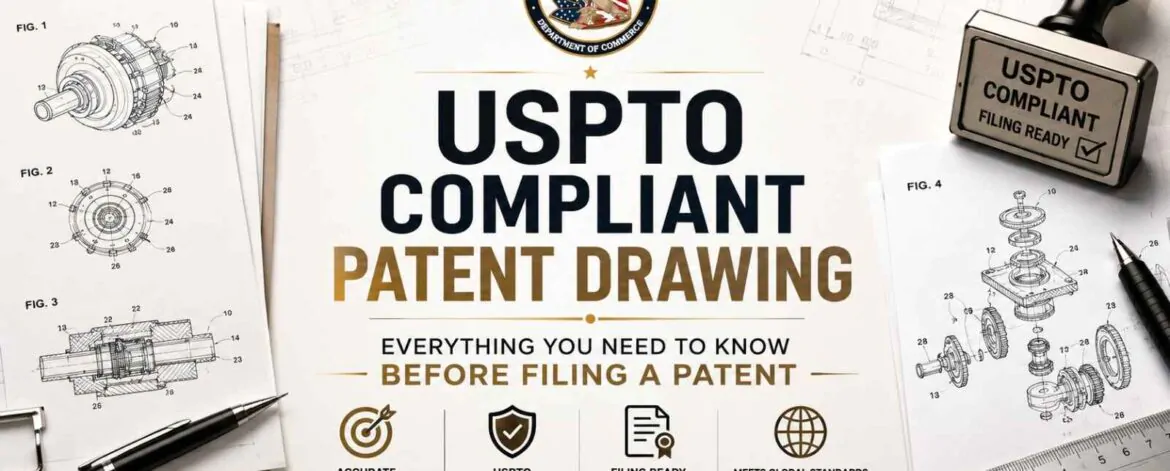
A USPTO Compliant Patent Drawing is a technical illustration prepared according to the drawing standards established by the United States Patent and Trademark Office (USPTO). These drawings clearly explain an invention’s structure, appearance, or operation and must meet specific formatting requirements to support a successful patent application.
Patent drawings are more than illustrations—they are an essential legal component of many patent applications. When prepared correctly, they help patent examiners understand an invention quickly, reduce misunderstandings, and minimize drawing-related objections during examination.
Whether you’re an inventor, patent attorney, startup, or corporation, understanding USPTO patent drawing requirements is an important step toward protecting your intellectual property.
What Is a USPTO Compliant Patent Drawing?
A USPTO Compliant Patent Drawing is a professional illustration that follows the official drawing standards required by the United States Patent and Trademark Office.
These drawings are designed to communicate the details of an invention with clarity and precision. They often accompany utility patent, design patent, and plant patent applications whenever visual representation is necessary to understand the invention.
Unlike ordinary technical illustrations, patent drawings must follow strict rules regarding layout, line quality, figure numbering, margins, reference numerals, and overall presentation.
Because patent drawings become part of the official patent record, accuracy is critical.
Why Are USPTO Compliant Patent Drawings Important?
Many inventors focus on writing strong patent claims and detailed specifications while overlooking the importance of professional drawings.
However, patent examiners frequently rely on drawings to interpret an invention. Clear illustrations improve communication between inventors, patent attorneys, and examiners, making the examination process more efficient.
Professionally prepared drawings can help:
- Explain complex inventions visually
- Improve understanding of technical features
- Support the written patent specification
- Reduce drawing-related office actions
- Save time during examination
- Strengthen the overall patent application
Submitting drawings that fail to meet USPTO standards may result in requests for replacement drawings, delaying prosecution and increasing costs.
When Are Patent Drawings Required?
Not every patent application requires drawings, but most utility and design patent applications include them because they help explain the invention.
Patent drawings are commonly required for:
- Mechanical inventions
- Consumer products
- Medical devices
- Electrical systems
- Manufacturing equipment
- Automotive components
- Industrial machinery
- Electronic devices
- Household products
Even relatively simple inventions often benefit from detailed patent illustrations because they improve clarity and reduce ambiguity.
Types of USPTO Patent Drawings
Depending on the type of patent application, different drawing styles may be required.
Utility Patent Drawings
Utility patent drawings illustrate how an invention functions.
These drawings commonly include:
- Component labels
- Reference numerals
- Cross-sectional views
- Exploded views
- Flowcharts
- Mechanical assemblies
- System diagrams
The objective is to explain the invention’s operation and technical structure.
Design Patent Drawings
Design patent drawings protect the ornamental appearance of a product.
These drawings emphasize:
- Shape
- Surface details
- Contours
- Configuration
- Decorative features
Because the drawings define the claimed design, precision is especially important.
Replacement Patent Drawings
Replacement drawings are submitted when the USPTO identifies problems with the original drawings.
Common reasons include:
- Incorrect formatting
- Missing views
- Poor image quality
- Figure numbering errors
- Inconsistent reference numerals
Preparing replacement drawings correctly helps keep the application moving forward.
Essential Requirements for USPTO Compliant Patent Drawings
Preparing compliant patent drawings requires attention to detail.
Some of the most important requirements include:
Clear Line Quality
Lines should be clean, consistent, and easy to reproduce.
Broken or uneven lines can reduce drawing clarity.
Proper Figure Numbering
Each illustration must have its own figure number.
Figures should appear in logical order and correspond directly with the written specification.
Accurate Reference Numerals
Utility patent drawings generally include numbered components.
These reference numerals should remain consistent throughout the application.
Appropriate Margins
Patent drawings should include sufficient margins to meet USPTO formatting standards.
Improper page layout may require replacement drawings.
Legible Text
Any required lettering or symbols should remain readable after reproduction.
Small or crowded text can make drawings difficult to interpret.
Consistent Views
Every figure should accurately represent the invention.
Multiple views should remain consistent and align with one another.
Common Mistakes That Cause Objections to USPTO Drawings
Drawing-related objections are more common than many inventors realize.
Some of the most frequent mistakes include:
Missing Drawing Views
Omitting an important view may prevent examiners from understanding the invention completely.
Poor Resolution
Low-quality images often become unreadable during electronic filing.
Incorrect Reference Numbers
Numbering inconsistencies between drawings and specifications create confusion.
Improper Line Thickness
Lines should remain clear and consistent throughout every figure.
Missing Labels
Important components should be properly identified whenever required.
Inconsistent Figures
Different views should accurately represent the same invention without conflicting details.
Professional patent illustrators help eliminate these issues before filing
Best Practices for Preparing USPTO Compliant Patent Drawings
Inventors can improve the quality of their applications by following several best practices.
Start Early
Preparing drawings at the beginning of the patent drafting process allows time for revisions before filing.
Work From Detailed Information
Providing sketches, CAD models, photographs, or engineering drawings helps professional illustrators prepare accurate patent figures.
Coordinate With Your Patent Attorney
Patent drawings should support the written specification and claims.
Close collaboration between illustrators and attorneys improves consistency.
Review Every Figure Carefully
Before filing, verify:
- Figure numbers
- Labels
- Reference numerals
- Views
- Line quality
- Overall accuracy
Small corrections before filing can prevent significant delays later.
Why Professional Patent Drawing Services Matter
While many inventors have access to design software, preparing USPTO-compliant drawings requires specialized knowledge.
Professional patent illustrators understand:
- USPTO formatting rules
- Patent office expectations
- Technical illustration standards
- Drawing conventions
- International filing requirements
Their experience helps reduce errors while producing illustrations suitable for patent prosecution.
Working with professionals also allows inventors and patent attorneys to focus on developing strong patent claims rather than correcting drawing issues.
Frequently Asked Questions
What Is a USPTO Compliant Patent Drawing?
A USPTO Compliant Patent Drawing is a professional illustration prepared according to official USPTO standards for patent applications.
Are Patent Drawings Required for Every Patent?
Most utility and design patent applications include drawings whenever they help explain the invention.
Can I Submit Hand-Drawn Patent Drawings?
While rough sketches may help during preparation, final patent drawings should meet USPTO quality and formatting standards.
Can Patent Drawings Be Corrected After Filing?
Yes. If the USPTO identifies drawing problems, applicants may submit replacement drawings that comply with official requirements.
Why Should I Hire a Professional Patent Illustrator?
Professional illustrators understand patent drawing rules, reduce filing errors, improve application quality, and help minimize drawing-related office actions.
Final Thoughts
A USPTO Compliant Patent Drawing is one of the most important components of a successful patent application. High-quality illustrations help patent examiners understand your invention, strengthen the written specification, and improve the overall clarity of the application.
Whether you are filing a utility patent, design patent, or submitting replacement drawings, following USPTO drawing standards can reduce delays, minimize objections, and support a more efficient examination process.
Investing in professional patent drawings is a practical step toward protecting your innovation and presenting it with confidence.
Get Professional USPTO Compliant Patent Drawings from The Patent Drawing Services
At The Patent Drawing Services, we specialize in creating accurate, high-quality, and USPTO-compliant patent illustrations for inventors, patent attorneys, startups, corporations, and law firms.
Our services include:
✔ Utility Patent Drawings
✔ Design Patent Drawings
✔ Trademark Drawings
Whether you’re preparing a new patent application or need corrected replacement drawings, our experienced team is ready to help.
Partner with The Patent Drawing Services and ensure your next patent application includes professional USPTO Compliant Patent Drawings that meet the highest standards of quality and accuracy.