The telecommunications industry is transforming rapidly with the expansion of 5G networks, Internet of Things (IoT) devices, cloud-based communication systems, and advanced wireless technologies. As companies and inventors develop new communication solutions, securing patent protection has become more important than ever. A key part of every successful patent application is meeting the Patent Drawing Requirements established by patent offices.
Patent drawings are not simply illustrations—they are official technical documents that help explain an invention to patent examiners. For complex telecommunications technologies, accurate drawings improve understanding of network architecture, hardware components, signal flow, and system operation. Whether filing with the United States Patent and Trademark Office (USPTO), the European Patent Office (EPO), or through the World Intellectual Property Organization (WIPO) under the Patent Cooperation Treaty (PCT), applicants must submit drawings that follow each office’s formatting rules.
The Patent Drawing Services provides professionally prepared Utility Patent Drawing, Design Patent Drawing, and Trademark Drawing services that help inventors, patent attorneys, and businesses submit clear, compliant patent applications worldwide.
Why Patent Drawing Requirements Are Important
Telecommunications inventions often include numerous electronic components working together within a single system. Patent drawings make these technical relationships easier to understand by visually presenting every essential feature described in the patent specification.
Meeting Patent Drawing Requirements offers several advantages:
- Improves the clarity of the invention
- Supports the written patent description
- Helps patent examiners understand complex technologies
- Reduces the possibility of drawing objections
- Creates publication-ready patent illustrations
- Supports patent applications in multiple jurisdictions
Clear drawings can save valuable time during patent examination by minimizing requests for corrected figures.
Telecommunications Technologies That Require Patent Drawings
Modern communication technologies cover a wide range of innovations, including:
- 5G infrastructure
- Wireless communication devices
- Mobile phones
- Antenna systems
- Base stations
- Network equipment
- Optical communication devices
- IoT products
- RF modules
- Communication processors
- Smart networking equipment
- Edge computing devices
Each invention requires illustrations that accurately represent the technical features while complying with official Patent Drawing Requirements.
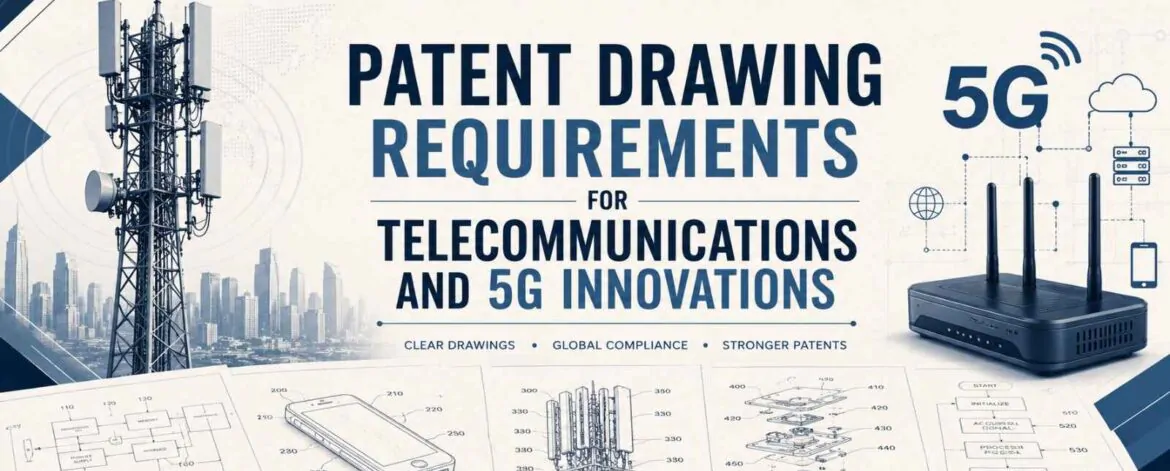
Common Patent Drawings Used in Telecommunications Applications
Different types of figures are used depending on the nature of the invention.
System Architecture Diagrams
These drawings show how different communication devices interact within a complete network.
Typical components include:
- User devices
- Wireless towers
- Servers
- Communication links
- Cloud infrastructure
Hardware Views
Perspective views illustrate the external appearance of communication equipment such as routers, transmitters, receivers, or handheld devices.
Exploded Assembly Drawings
Exploded figures separate individual components to clearly illustrate how devices are assembled.
These are commonly used for:
- Antenna systems
- Electronic housings
- Modular communication devices
Cross-Sectional Views
Cross-sectional drawings display internal structures that are hidden from the exterior.
Examples include:
- Circuit boards
- RF shielding
- Internal connectors
- Antenna placement
Block Diagrams
Block diagrams simplify complex communication systems by showing the relationship between functional modules.
Examples include:
- Processor
- Memory
- Transceiver
- Power supply
- Communication controller
Process Flow Diagrams
Flow diagrams illustrate communication methods or operational sequences, such as:
- Device authentication
- Data transmission
- Signal processing
- Network registration
Patent Drawing Requirements for Telecommunications Inventions
Patent offices expect drawings to meet specific formatting standards. While requirements vary slightly among jurisdictions, several general rules apply.
Professional patent drawings should include:
- Clear black line illustrations
- Uniform line thickness
- Proper figure numbering
- Consistent reference numerals
- Readable lettering
- Adequate spacing between components
- Correct page margins
- Clean layout without unnecessary graphics
Following these Patent Drawing Requirements helps ensure drawings are suitable for publication and examination.
USPTO Patent Drawing Requirements
The USPTO requires drawings whenever they are necessary to understand the claimed invention.
Important requirements include:
- Black-and-white line drawings
- Sharp, clean lines
- Consecutively numbered figures
- Reference numbers matching the specification
- Proper margins
- No decorative elements
- High readability
Before further review, applications that don’t adhere to USPTO drawing requirements may be subject to objections asking for replacement drawings.
EPO Patent Drawing Requirements
The EPO requires technical drawings that clearly illustrate every important feature of the invention.
Applicants should ensure:
- Uniform drawing quality
- Clear labeling
- Proper spacing
- Accurate reference numbers
- Consistent figure presentation
- High-quality reproduction
Well-prepared drawings improve examination efficiency and publication quality.
WIPO Patent Drawing Requirements
International patent applications submitted through WIPO under the Patent Cooperation Treaty (PCT) should include drawings that satisfy international publication standards.
WIPO emphasizes:
- Publication-quality illustrations
- Uniform formatting
- Clear reference numerals
- Accurate technical representation
- Consistent figure layout
Preparing compliant drawings at the international filing stage helps simplify later national phase applications.
Common Drawing Errors to Avoid
Many patent applications require drawing corrections because of avoidable mistakes.
Some of the most common include:
- Poor image quality
- Inconsistent numbering
- Missing reference numerals
- Overlapping labels
- Incorrect page margins
- Crowded figures
- Incomplete component identification
- Unclear line work
Professional preparation significantly reduces these issues.
Why Professional Patent Drawings Matter
Telecommunications inventions often involve advanced engineering concepts that must be communicated accurately through illustrations.
Professional patent illustrators understand how to prepare figures that:
- Clearly explain complex inventions
- Follow patent office standards
- Support patent specifications
- Improve overall application quality
- Reduce drawing-related objections
This expertise becomes especially valuable for inventions involving wireless communication systems and network technologies.
The Patent Drawing Services
Preparing compliant patent drawings requires technical knowledge and familiarity with international patent office requirements.
The Patent Drawing Services offers professional illustration solutions for inventors, patent professionals, law firms, startups, universities, and technology companies.
Utility Patent Drawing
Our Utility Patent Drawing service provides accurate technical illustrations for:
- Communication devices
- Electronic systems
- Network equipment
- Wireless technologies
- Mechanical inventions
- Electrical innovations
Every drawing is prepared according to recognized Patent Drawing Requirements.
Design Patent Drawing
Our Design Patent Drawing service focuses on the ornamental appearance of products through detailed line drawings that meet patent office standards.
Trademark Drawing
We also prepare Trademark Drawings for logos, symbols, and design marks suitable for trademark application filings.
Best Practices for Patent Drawings
Applicants can improve their patent applications by following several best practices.
- Prepare drawings before filing the application.
- Ensure every claimed feature appears in the figures.
- Use consistent reference numerals.
- Keep drawings uncluttered.
- Include additional views when necessary.
- Verify compliance with USPTO, EPO, and WIPO guidelines.
- Review every figure carefully before submission.
These practices help create accurate and professional patent illustrations.
Conclusion
As telecommunications technologies continue to advance, high-quality patent drawings remain an essential part of the patent application process. Meeting Patent Drawing Requirements helps inventors present their innovations clearly, supports the written specification, and improves compliance with the standards established by the USPTO, EPO, and WIPO.
Whether protecting a wireless communication device, network equipment, or another telecommunications invention, professionally prepared drawings contribute to a stronger patent application.
The Patent Drawing Services provides reliable Utility Patent Drawing, Design Patent Drawing, and Trademark Drawing services to help inventors and businesses prepare publication-ready patent illustrations that meet international patent office requirements. Our experienced team is committed to delivering accurate, compliant, and high-quality drawings that support successful patent filings.