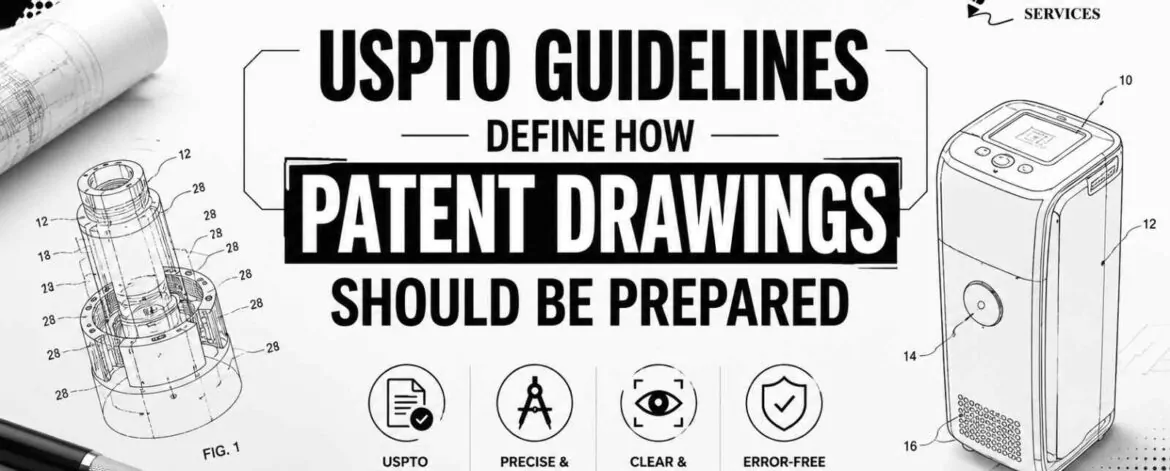
Patent drawings should be prepared according to the standards that USPTO guidelines define to ensure every invention is clearly represented and ready for examination. Accurate patent drawings are more than simple illustrations—they are an essential part of a successful patent application. Poor-quality drawings can delay prosecution, trigger office actions, or even affect the scope of patent protection.
Whether you are filing a utility patent, design patent, or international application, understanding how USPTO guidelines define drawing requirements is essential. This guide explains the key standards, common mistakes, international considerations, and how The Patent Drawing Services helps inventors, patent attorneys, and businesses create compliant patent illustrations.
Why Patent Drawings Matter
Patent drawings communicate the technical details of an invention in a visual format. In many patent applications, drawings help patent examiners understand structures, components, relationships, and operational features that may be difficult to explain using text alone.
When patent drawings should be prepared correctly, they offer several advantages:
- Improve the clarity of the invention.
- Reduce examiner confusion.
- Support patent claims.
- Minimize delays caused by drawing objections.
- Increase the professionalism of the application.
The USPTO expects drawings to meet strict formatting standards before an application proceeds smoothly through examination.
USPTO Guidelines Define Drawing Standards
The USPTO guidelines define specific rules that applicants must follow when preparing patent drawings. These standards ensure consistency across all patent applications and make examination easier.
Some of the primary requirements include:
1. Clear Black Lines
Patent drawings should use solid black lines with consistent thickness. Lines must remain clear after electronic scanning and reproduction.
2. White Background
The drawing sheet should have a clean white background without shading or colored elements unless specifically permitted by the USPTO.
3. Proper Margins
The USPTO requires minimum margins on every drawing sheet. These margins ensure that drawings remain readable during storage, scanning, and publication.
4. Correct Sheet Size
Patent drawing sheets must follow the approved paper dimensions established by the USPTO.
5. Figure Numbering
Every illustration should include sequential figure numbers such as FIG. 1, FIG. 2, and FIG. 3. Each figure must correspond with the written specification.
6. Reference Numerals
Every important component should have a unique reference numeral that matches the patent description. Reference numbers should remain consistent throughout all figures.
Because USPTO guidelines define these standards clearly, following them reduces the likelihood of receiving drawing objections.
Patent Drawings Should Be Prepared with Accuracy
Accuracy is one of the most important elements of patent illustrations.
Patent drawings should be prepared to accurately represent the invention without exaggeration or omission. Every visible feature shown in the drawings should support the written specification.
Professional patent illustrators understand how to:
- Maintain correct proportions.
- Present multiple views.
- Highlight essential components.
- Eliminate unnecessary details.
- Ensure consistency across all figures.
Small errors may create confusion during examination, making professional preparation highly valuable.
Utility Patent Drawings
Utility patents often require technical illustrations showing how an invention works.
These drawings may include:
- Perspective views
- Cross-sectional views
- Exploded views
- Flowcharts
- System diagrams
- Process illustrations
Utility patent drawings help examiners understand functionality rather than appearance.
At The Patent Drawing Services, professional illustrators prepare Utility Patent Drawings that comply with USPTO standards while clearly communicating complex inventions.
Design Patent Drawings
Design patents protect the ornamental appearance of products.
For design applications, drawings become the primary disclosure of the claimed design. Even minor inconsistencies may affect patent scope.
Design patent drawings commonly include:
- Front view
- Rear view
- Top view
- Bottom view
- Left side view
- Right side view
- Perspective view
Broken lines, surface shading, and contour lines must follow USPTO requirements carefully.
The Design Patent Drawing service from The Patent Drawing Services helps applicants produce publication-ready illustrations that satisfy USPTO expectations.
Trademark Drawings
Trademark applications also require accurate representations of logos, symbols, or word marks.
Trademark drawings should present:
- Clear artwork
- Proper proportions
- Accurate lettering
- High-quality resolution
The Patent Drawing Services provides professional Trademark Drawing services that help businesses submit clean and compliant trademark representations.
International Patent Drawing Standards
Inventors often seek protection beyond the United States.
Although USPTO guidelines define U.S. drawing standards, many international patent offices have similar expectations.
USPTO
The United States Patent and Trademark Office emphasizes clarity, proper margins, reference characters, and standardized figure formatting.
EPO
The European Patent Office (EPO) requires technically accurate drawings with consistent reference numerals and high reproduction quality. While many standards resemble USPTO rules, applicants should review EPO-specific requirements before filing.
WIPO
Applications filed through the Patent Cooperation Treaty (PCT) under WIPO also require drawings that meet international formatting standards. High-quality drawings help facilitate examination across multiple jurisdictions.
Preparing drawings that satisfy USPTO, EPO, and WIPO standards can simplify international patent prosecution and reduce the need for later revisions.
Why Professional Patent Drawings Make a Difference
Preparing compliant patent drawings requires technical knowledge, drafting experience, and familiarity with patent office regulations.
Professional illustrators understand:
- USPTO formatting rules
- Patent examiner expectations
- Technical illustration standards
- CAD conversion
- Line quality
- Section views
- Exploded diagrams
- Design patent requirements
Instead of revising drawings after receiving objections, applicants can submit publication-quality illustrations from the beginning.
Why Choose The Patent Drawing Services?
The Patent Drawing Services specializes in creating accurate, compliant, and professional patent illustrations for inventors, patent law firms, startups, universities, and corporations.
Our services include:
Utility Patent Drawing
Professionally prepared utility patent illustrations that clearly explain the invention while complying with USPTO requirements.
Design Patent Drawing
Detailed design patent drawings that accurately capture ornamental features and satisfy filing standards.
Trademark Drawing
High-quality trademark representations suitable for USPTO trademark applications.
Every project is reviewed carefully to ensure clarity, consistency, and compliance with current patent office requirements.
Best Practices Before Filing
Before submitting your patent application, review the following checklist:
- Verify all figures are numbered correctly.
- Confirm reference numerals match the specification.
- Ensure line quality is consistent.
- Check margins and sheet size.
- Remove unnecessary artistic effects.
- Include every required view.
- Review drawings for readability after electronic scanning.
- Confirm compliance with USPTO guidelines.
Following these steps helps reduce delays and improves examination efficiency.
Final Thoughts
Because USPTO guidelines define the standards that govern patent illustrations, every inventor should understand how patent drawings should be prepared before filing an application. Well-prepared drawings improve communication, strengthen the overall application, and help patent examiners evaluate inventions efficiently.
Whether you are pursuing protection in the USPTO, expanding internationally through the EPO or WIPO, or preparing a new patent portfolio, professionally prepared drawings are a valuable investment.
The Patent Drawing Services provides expert Utility Patent Drawing, Design Patent Drawing, and Trademark Drawing solutions designed to meet the latest patent office requirements. By partnering with experienced professionals, inventors and businesses can submit accurate, publication-ready patent drawings that support a smoother patent filing process and improve the overall quality of their applications.