When you’re preparing a patent application, one thing quickly becomes clear your drawings matter just as much as your written description. They are not just supporting visuals. They are a key part of how your invention is explained and understood.
A common question many inventors face is: What kind of drawings should I use? More specifically, people often struggle to understand Patent Perspective Views vs. Orthographic Projections.
If you get this part wrong, your application can become confusing, and that may lead to objections or delays. But if you get it right, your drawings can make your invention much easier to understand.
In this guide, we’ll explain everything in a simple and practical way so you know exactly how to use both types of drawings.
Why Patent Drawings Are So Important
Before comparing the two, let’s talk about why drawings matter in the first place.
When a patent examiner reviews your application, they don’t rely only on text. In fact, drawings often help them understand your invention faster than written descriptions.
Good drawings can:
- Clearly show how your invention looks and works
- Support your claims
- Reduce confusion
- Help avoid unnecessary questions or objections
On the other hand, poor drawings can slow everything down.
That’s why understanding Patent Perspective Views vs. Orthographic Projections is important—it helps you present your invention the right way.
What Is a Perspective View?
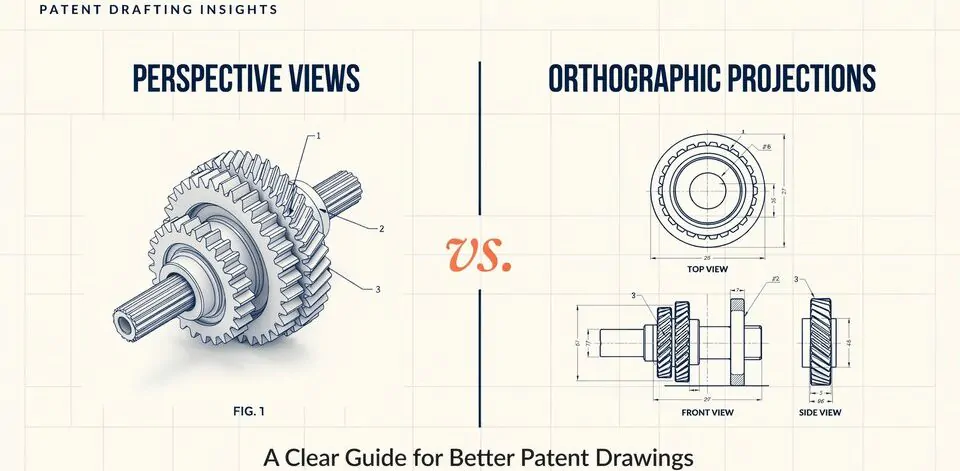
A perspective view shows your invention in a way that looks natural, almost like how your eyes would see it in real life.
Instead of showing just one side, it shows multiple sides at once, giving a sense of depth.
Simple way to understand it:
Imagine looking at your product from a corner you can see the front, side, and top all together. That’s a perspective view.
Why it’s useful:
- Gives a quick overall understanding
- Helps visualize the shape and design
- Makes the drawing easy to recognize
In many patent applications, this is the first drawing someone looks at.
What Are Orthographic Projections?
Orthographic projections are more technical. They break your invention into multiple flat views, each showing one side clearly.
Common views include:
- Front view
- Top view
- Side view
- Sectional view (if internal parts are involved)
Simple way to understand it:
It’s like looking at your invention straight from the front, then from the side, then from the top—one view at a time.
Why it’s useful:
- Shows exact structure
- Explains how parts are arranged
- Provides technical clarity
In the comparison of Patent Perspective Views vs. Orthographic Projections, orthographic drawings focus more on accuracy than appearance.
The Main Difference (In Everyday Language)
Let’s keep it simple:
- Perspective view = shows how your invention looks
- Orthographic projections = show how your invention is built
One helps you understand the overall shape.
The other helps you understand the details.
This is the core idea behind Patent Perspective Views vs. Orthographic Projections.
Do You Have to Choose One?
No and here is where a lot of folks become perplexed.
You don’t have to choose between perspective views and orthographic projections. In fact, most patent applications use both.
Each type solves a different problem:
- Perspective views give a quick overview
- Orthographic projections provide detailed clarity
Using both together gives a complete picture of your invention.
When to Use Perspective Views
Perspective views are especially useful when:
- You want to show the overall design
- The shape or appearance is important
- You need a strong first impression
- You’re working on a design-focused invention
These drawings help someone instantly recognize your invention.
When to Use Orthographic Projections
Orthographic projections are necessary when:
- Your invention has multiple components
- Internal details need to be explained
- Each side has unique features
- Accuracy is important
These views make sure nothing is misunderstood.
A Simple Example
Let’s say you’ve invented a new type of bottle.
- A perspective view shows the full bottle in one image
- Orthographic views show the front, side, and top separately
The perspective view helps you “see” the bottle.
The orthographic views help you understand its exact shape and structure.
This is how Patent Perspective Views vs. Orthographic Projections work together in real situations.
Why Using Only One Type Can Be a Problem
If you rely only on one type of drawing, you may run into issues.
Only perspective view:
- Looks good
- But may miss important details
Only orthographic projections:
- Technically correct
- But harder to visualize
That’s why combining both is the best approach.
Best Practice: Use Both Together
A strong patent drawing set usually includes:
- A perspective view for overall understanding
- Multiple orthographic views for detailed explanation
- Sectional views if internal parts are important
This combination ensures your drawings are complete and clear.
Common Mistakes to Avoid
Many applications face issues because of simple mistakes. Here are some things to be aware of:
- Missing important views
- Using inconsistent proportions
- Overcomplicating perspective drawings
- Poor alignment in orthographic views
- Lack of clarity in labeling
Avoiding these mistakes can save you time and effort.
Why Professional Help Makes a Difference
Patent drawings are not just about making something look good. They must follow specific rules and standards.
That’s why many inventors choose professionals like The Patent Drawing Services.
They understand how to balance Patent Perspective Views vs. Orthographic Projections and create drawings that meet all requirements.
Services Offered by The Patent Drawing Services
If you want to make sure your drawings are done right, here’s how their services can help:
Utility Patent Drawing
These illustrations highlight the operation of your idea. To provide a comprehensive knowledge, they employ perspective views and orthographic projections to display information.
Design Patent Drawing
These drawings focus on appearance. Perspective views play a big role here, supported by clean orthographic views for accuracy.
Trademark Drawing
These are used for logos and brand elements. They require clarity and precision but are usually simpler than patent drawings.
Using these services ensures your drawings are both professional and compliant.
Simple Tips for Better Patent Drawings
If you’re creating drawings yourself, here are a few tips:
- Always include at least one perspective view
- Add enough orthographic views to cover all sides
- Keep lines clean and consistent
- Label all parts clearly
- Avoid unnecessary complexity
These small improvements can make your drawings much more effective.
Long-Term Benefits of Getting It Right
When you properly use Patent Perspective Views vs. Orthographic Projections, you gain several advantages:
- Faster review process
- Fewer objections
- Better understanding of your invention
- Stronger patent protection
Good drawings don’t just help you get approved they help protect your idea in the long run.
Final Thoughts
At the end of the day, patent drawings are about communication. You’re trying to explain your invention as clearly as possible.
Perspective views help people see the full picture, while orthographic projections help them understand the technical details. Using both together is the best way to create strong, clear, and effective patent drawings that support a successful patent application.
The importance of high-quality patent drawings is recognized by major patent authorities, including the USPTO (United States Patent and Trademark Office), which requires drawings to clearly disclose the invention and comply with specific formatting standards.
If you want to avoid mistakes, reduce delays, and save valuable time, working with experts like The Patent Drawing Services can make the process much easier. Professional patent illustrations help ensure that your invention is presented accurately and meets patent office requirements.
Because in patent applications, it’s not just about having a great idea it’s about showing it in the clearest way possible.