Standard Essential Patent applications require precise, accurate, and USPTO-compliant drawings to clearly communicate an invention and support strong patent protection. Whether the invention involves wireless communication, semiconductor technology, networking protocols, or Internet of Things (IoT) devices, high-quality patent drawings play a critical role in helping examiners understand the technical features. A professionally prepared drawing package not only satisfies USPTO requirements but also reduces delays caused by drawing objections. For innovators seeking broad protection for technologies adopted across industries, investing in accurate patent illustrations is an essential step toward a successful filing.
Understanding a Standard Essential Patent
A Standard Essential Patent protects technology that is necessary to implement an industry standard established by a recognized standards organization. These patents are common in sectors such as telecommunications, consumer electronics, automotive systems, and wireless networking. Technologies used in 5G, Wi-Fi, Bluetooth, video coding, and smart devices often rely on patents considered essential to technical standards.
Because these inventions involve complex systems and multiple interconnected components, drawings become one of the most valuable parts of the patent application. They provide visual support for the written specification and help explain technical relationships that may be difficult to describe using words alone.
Why Patent Drawings Matter
Patent drawings are legal illustrations that support the disclosure of an invention. For a Standard Essential Patent, drawings can illustrate communication networks, hardware architecture, signal flow, processing units, software interaction, and electronic components. Examiners rely on these figures to understand how different elements operate together.
Clear drawings also benefit patent attorneys by making it easier to draft detailed specifications and claims. During patent examination, well-prepared illustrations can reduce misunderstandings and minimize requests for corrections. Accurate drawings are equally valuable when filing internationally because many patent offices follow similar technical drawing standards.
USPTO Drawing Requirements
The United States Patent and Trademark Office (USPTO) has established specific rules for patent drawings under 37 CFR 1.84. Every Standard Essential Patent application should comply with these standards before filing.
Drawings should use clean black lines on a white background with consistent line quality. Colors are generally not permitted unless special approval is obtained. Every sheet must include proper margins and clear figure numbering. Components shown in one figure should use the same reference numerals throughout the entire application. Each illustration should remain uncluttered, making every feature easy to identify.
Professional formatting helps avoid drawing objections that can delay examination and increase prosecution costs.
Essential Drawing Types
Different inventions require different illustration styles. A Standard Essential Patent application often includes multiple figure types to explain the technology completely.
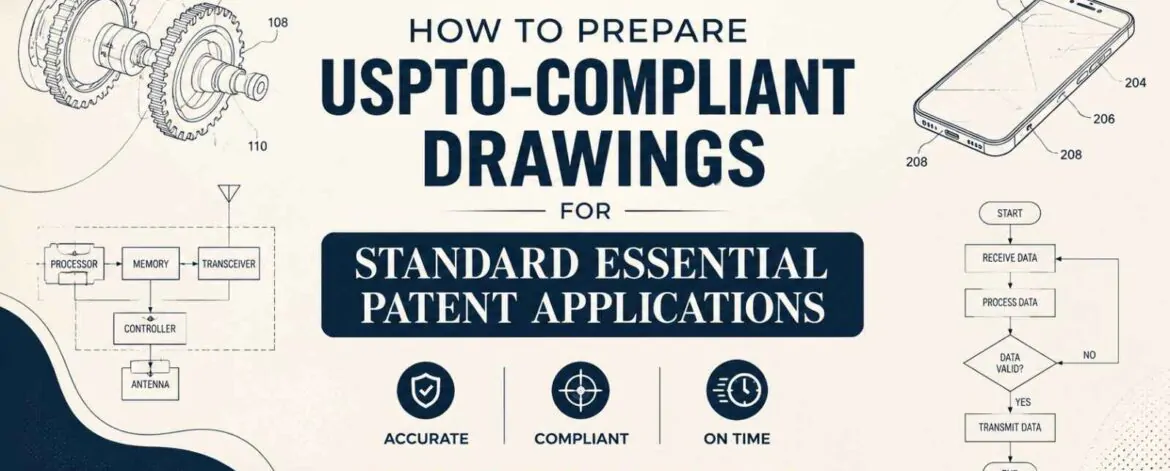
System architecture diagrams present the overall structure of communication systems, servers, mobile devices, processors, and network connections. These figures provide a high-level overview of how different components interact.
Block diagrams divide complex inventions into functional modules, making electronic systems easier to understand. They commonly include processors, memory units, communication interfaces, sensors, transmitters, receivers, and control modules.
Flowcharts describe operational sequences such as authentication procedures, signal processing, encryption methods, communication protocols, and data routing. These illustrations are especially useful for software-related inventions.
Circuit diagrams explain electrical connections, integrated circuits, switches, and electronic assemblies. For hardware innovations, these figures provide valuable technical detail.
User interface illustrations may also be included when the invention involves software displays or graphical controls. Each illustration should remain simple, clear, and compliant with USPTO standards.
Best Practices for Accurate Drawings
Preparing drawings begins with understanding the invention completely. Every figure should directly support the written specification without introducing unnecessary information. Consistency is extremely important throughout the drawing set.
Reference numerals should never change between figures. Labels must remain readable, and all lines should maintain uniform thickness. Figures should contain enough detail to explain the invention while avoiding overcrowding. If multiple views are necessary, they should be separated into different figures rather than compressed onto one sheet.
Inventors should carefully review every illustration before filing to ensure that each figure referenced in the specification appears in the drawing package.
Common Drawing Mistakes
Many patent applications receive drawing objections because of preventable errors. Low-resolution images, inconsistent numbering, missing figures, improper margins, blurred graphics, and handwritten corrections frequently result in additional examination requirements.
Another common mistake involves copying engineering drawings directly into a patent application. Engineering drawings often contain dimensions, manufacturing notes, colors, or symbols that are inappropriate for patent filing. Patent illustrations should focus only on features necessary to understand the invention while following USPTO formatting standards.
Professional review before submission can eliminate these issues and improve the overall quality of the application.
Why Professional Patent Drawing Services Are Important
Creating patent drawings for a Standard Essential Patent requires more than illustration skills. It demands a thorough understanding of patent regulations, technical documentation, and international filing practices. Professional patent illustrators know how to convert engineering sketches, CAD files, prototypes, and technical documents into clean, compliant patent figures that meet the expectations of patent examiners.
Working with experienced professionals provides several advantages. Drawings are prepared according to USPTO formatting standards, reference numerals remain consistent throughout the application, and figures are optimized for clarity. This reduces the likelihood of drawing objections and allows inventors and patent attorneys to focus on developing strong patent claims instead of correcting illustration errors.
Professional patent drawings also help maintain consistency when applications are filed in multiple jurisdictions. Since many Standard Essential Patent applications are eventually submitted internationally, using standardized drawings from the beginning can save both time and filing costs.
How The Patent Drawing Services Supports Innovators
The Patent Drawing Services specializes in preparing high-quality patent illustrations for inventors, startups, corporations, universities, and intellectual property law firms. Every drawing is carefully prepared to meet USPTO requirements while accurately representing the technical features of the invention.
Our Utility Patent Drawing service is designed for mechanical, electrical, software, medical, chemical, and communication inventions. Each drawing clearly illustrates functional components and technical relationships, helping examiners understand even the most complex innovations.
Our Design Patent Drawing service focuses on protecting the ornamental appearance of products. We prepare detailed line drawings with proper surface shading, perspective views, and multiple angles required for design patent applications. Every illustration is created with precision to support a strong design filing.
Our Trademark Drawing service assists businesses in preparing accurate trademark representations for logos, stylized text, and composite marks. Proper trademark drawings help ensure applications comply with filing requirements while accurately representing the brand identity.
Whether preparing a simple invention or a sophisticated Standard Essential Patent, our team delivers professional illustrations that support successful patent filings.
International Filing Considerations
Many inventors seek patent protection beyond the United States. A Standard Essential Patent often has commercial value in multiple countries because standardized technologies are adopted worldwide. Preparing drawings that satisfy international expectations can simplify later filings.
The USPTO requires patent drawings that clearly disclose the invention without unnecessary information. The EPO also emphasizes clarity, consistency, and proper presentation of figures during examination. Similarly, WIPO applies international standards when processing Patent Cooperation Treaty (PCT) applications, making professionally prepared drawings valuable for applicants pursuing global patent protection.
Using consistent drawings across different jurisdictions helps maintain technical accuracy and reduces the need for extensive revisions during international prosecution.
Final Checklist Before Filing
Before submitting a Standard Essential Patent application, inventors should verify that every drawing complies with USPTO standards. Check that all figures are clearly labeled, reference numerals remain consistent, margins meet official requirements, and every illustration matches the written specification. Ensure that no unnecessary text, colors, or manufacturing details appear in the drawings. Review each figure carefully to confirm that it accurately explains the invention and supports the patent claims.
Performing this final review can prevent unnecessary Office Actions and improve the efficiency of the examination process.
Conclusion
Preparing USPTO-compliant drawings is an essential step in securing protection for a Standard Essential Patent. Accurate illustrations improve the clarity of complex inventions, strengthen the overall patent application, and help examiners understand important technical features. Well-prepared drawings also reduce filing delays, minimize objections, and support international patent protection through organizations such as the USPTO, EPO, and WIPO.
If you are preparing a Standard Essential Patent application, partnering with experienced professionals can make a significant difference. The Patent Drawing Services provides reliable Utility Patent Drawing, Design Patent Drawing, and Trademark Drawing solutions that meet USPTO standards while delivering exceptional technical accuracy. Our experienced team is committed to producing clear, compliant, and publication-ready patent illustrations that help inventors, businesses, and patent professionals protect valuable innovations with confidence. Whether your invention supports next-generation communication systems, advanced electronics, or emerging technologies, professionally prepared patent drawings provide the visual foundation for a stronger patent application and long-term intellectual property success.