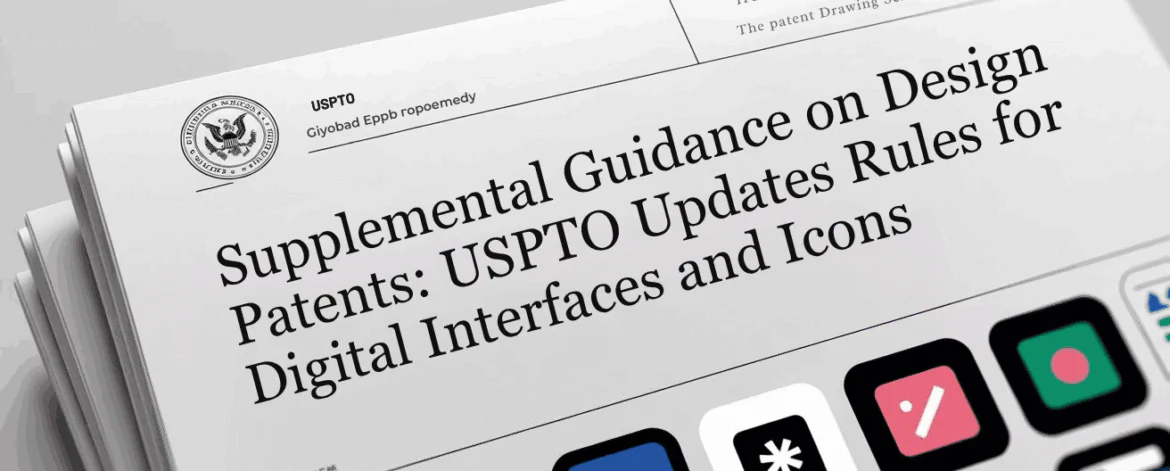
Digital products are changing faster than traditional patent practices. In March 2026, the United States Patent and Trademark Office (USPTO) published supplemental guidance that provides greater flexibility for design patent applications involving computer-generated interfaces, icons, projections, and holograms. The guidance is particularly important for applicants preparing Design Patent Drawing Rules for modern digital products.
The update helps align design patent examination with technologies such as graphical user interfaces (GUIs), augmented reality (AR), virtual reality (VR), projected displays, and holographic interfaces. For inventors and patent professionals, understanding these updated Design Patent Drawing Rules can help create clearer applications and avoid unnecessary drawing limitations.
What Changed in the 2026 USPTO Guidance?
The USPTO’s March 13, 2026, supplemental guidance addresses whether computer-generated interfaces and icons satisfy the “article of manufacture” requirement under 35 U.S.C. §171. The USPTO specifically removed the requirement for certain applications to depict the article of manufacture in solid or broken lines when the title and claim properly identify an article of manufacture.
This is an important change because applicants may have more flexibility when presenting a digital design. Instead of unnecessarily surrounding an icon or interface with a computer, smartphone, or display, the application may focus more directly on the claimed visual design when the statutory and procedural requirements are satisfied.
These updated Design Patent Drawing Rules are especially relevant to companies developing software interfaces, digital controls, AR experiences, VR environments, vehicle displays, and other emerging technologies.
Standalone Computer-Generated Images
One of the most useful aspects of the new guidance is the treatment of computer-generated interfaces and icons.
Previously, applicants often used a physical computer or display as environmental context and relied on broken lines to indicate that the device itself was not claimed. The 2026 guidance removes that drawing requirement in qualifying cases when the title and claim appropriately identify the article of manufacture.
This means a digital interface can potentially be presented without unnecessary hardware surrounding it. For patent drawing professionals, this creates an opportunity to produce cleaner illustrations that place greater emphasis on the ornamental features that actually define the design.
However, applicants should not interpret the change as meaning that every digital image automatically qualifies for design patent protection. The claim must still be directed to eligible subject matter, and the application must satisfy the applicable statutory and formal requirements.
Holograms and Projections Receive Important Recognition
Another major development concerns projections and holograms.
The USPTO’s updated guidance recognizes computer-generated interfaces and icons, including certain projections and holograms, as potentially patent-eligible designs when the requirements are satisfied. The guidance explains that such designs can be more than a transient or disembodied image when appropriately disclosed and claimed for a computer, computer display, or computer system.
This matters for businesses developing:
- AR and VR interfaces
- Automotive heads-up displays
- Holographic controls
- Projected user interfaces
- Three-dimensional digital icons
- Interactive display systems
For these technologies, carefully prepared Design Patent Drawing Rules can help applicants communicate the appearance of the claimed design without adding unnecessary environmental limitations.
How Broken Lines Should Be Considered
Broken lines remain an important drawing tool, but their role should be evaluated carefully under the updated guidance.
When environmental structure is relevant to showing how a design appears, broken lines may help communicate context without necessarily making that structure part of the claimed design. For example, an applicant may use environmental features to demonstrate where a projection or interface appears while distinguishing those features from the ornamental design being claimed.
At the same time, the 2026 guidance removes the previous requirement to depict the article of manufacture in solid or broken lines for qualifying computer-generated interface and icon applications when the title and claim properly identify the article of manufacture.
Therefore, applicants should not automatically add a device outline simply because older examples commonly used one. The best approach under the updated Design Patent Drawing Rules is to determine what visual information is necessary to clearly communicate the claimed design.
The Article of Manufacture Requirement Still Matters
The new guidance does not eliminate the article of manufacture requirement.
Under 35 U.S.C. §171, a design patent must still be directed to a qualifying design for an article of manufacture. The 2026 guidance changes how certain computer-generated interfaces and icons may be presented and claimed; it does not turn abstract digital concepts into patentable designs.
This distinction is critical.
A general idea for an attractive interface is different from the ornamental appearance of a specific computer-generated interface for a computer, computer display, or computer system. Applicants should work with patent counsel to ensure that the title, claim, specification, and drawings work together to satisfy the statutory requirements.
What This Means for Patent Drawings
The new Design Patent Drawing Rules make drawing strategy more important, not less.
A high-quality design patent drawing should communicate the claimed appearance clearly and consistently. For digital designs, this can include precise geometry, consistent line weights, accurate proportions, appropriate shading, and carefully selected views.
For example, an interface with multiple screens or states may require several views to communicate the complete ornamental appearance. An icon may need only a focused presentation, while a three-dimensional projected design may benefit from views that clearly demonstrate its shape and visual characteristics.
The objective is not simply to create attractive images. Patent drawings must accurately define and support the claimed design.
Why Patent Attorneys Should Review Existing Applications
Patent attorneys and IP teams should consider reviewing pending applications involving computer-generated interfaces, icons, projections, and holograms.
The updated guidance may create opportunities to reconsider how certain applications present their designs. In some situations, applicants may determine that unnecessary environmental structure can be avoided or that a different drawing strategy better communicates the intended scope.
Any amendment, continuation, or prosecution strategy should be evaluated on the individual facts of the application and in consultation with qualified patent counsel.
The USPTO has also provided examiner training materials concerning the March 2026 guidance, showing that the Office is incorporating the updated approach into design patent examination.
Practical Tips for Applicants
When preparing an application under the updated Design Patent Drawing Rules, consider these practical steps:
- Identify the actual claimed design.
Determine which visual elements represent the ornamental design and which elements are merely environmental. - Review the title and claim.
For computer-generated interfaces and icons, the title and claim should properly identify the relevant article of manufacture. - Avoid unnecessary hardware.
Do not automatically include a smartphone, computer, or monitor simply because older practices commonly displayed digital designs on physical devices. - Use environmental features carefully.
Where context is useful, determine whether broken-line representation is appropriate and consistent with the intended claim. - Select views strategically.
Use enough views to fully communicate the appearance without introducing unnecessary or inconsistent information. - Maintain drawing consistency.
Every figure should accurately represent the same claimed design and follow applicable USPTO drawing requirements.
How The Patent Drawing Services Can Help
The updated Design Patent Drawing Rules make professional preparation increasingly valuable for digital inventions.
At The Patent Drawing Services, design patent drawings can be prepared for modern digital products, including interfaces, icons, projected designs, and other computer-generated visual concepts. Professional drawing support can help ensure that figures are clean, consistent, and prepared with the applicable USPTO requirements in mind.
Our services also include utility patent drawings and trademark drawings for applicants and businesses seeking broader intellectual property support.
Conclusion
The USPTO’s March 2026 guidance represents an important modernization of design patent examination for computer-generated interfaces and icons. It provides greater flexibility in how qualifying digital designs can be presented while maintaining the fundamental requirement that the design be directed to an article of manufacture.
For inventors, software companies, patent attorneys, and IP professionals, the updated Design Patent Drawing Rules provide an opportunity to rethink traditional approaches to digital design protection. Clear claims, appropriate titles, accurate specifications, and professionally prepared drawings can work together to present the ornamental design more effectively.
As interfaces, holograms, projections, AR, and VR continue to evolve, patent drawing strategies must evolve with them. Staying current with USPTO guidance can help applicants prepare stronger and more clearly presented design patent applications.