
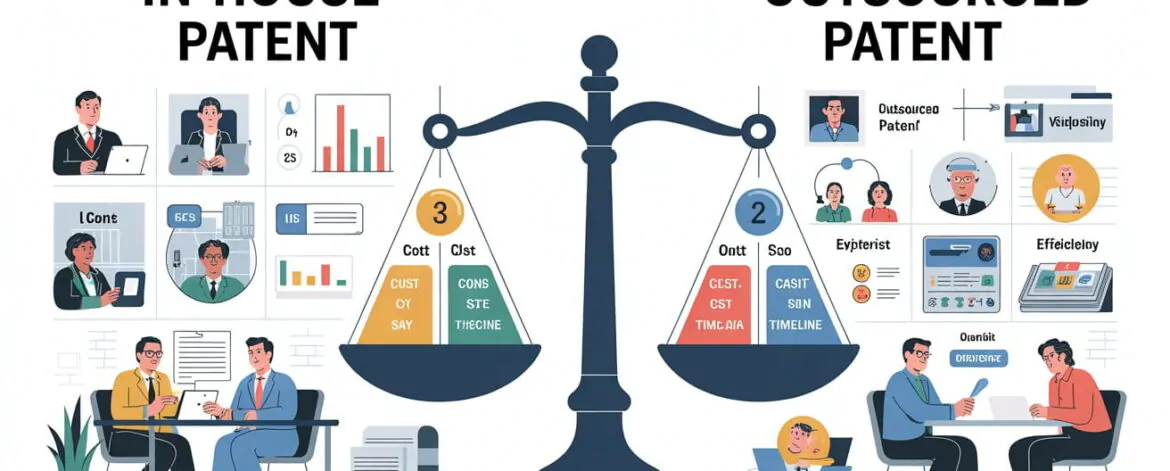
In today’s competitive innovation landscape, protecting intellectual property is essential for businesses of every size. Companies developing new products, technologies, or processes must decide how to manage patent-related work efficiently. One of the most important decisions is In House vs Outsourced Patent services. Should your business build an internal patent team, or should it work with experienced external professionals?
The answer depends on your budget, workload, technical requirements, confidentiality needs, and long-term intellectual property strategy. Understanding the differences can help you select a model that improves quality, controls costs, and supports faster patent filing.
What Does In House vs Outsourced Patent Mean?
The In House vs Outsourced Patent decision is essentially about where patent-related responsibilities are handled.
An in-house model means a company employs its own patent attorneys, agents, engineers, paralegals, and technical drawing professionals. These employees manage patent research, drafting, drawings, filing support, and portfolio-related activities internally.
An outsourced model means the company works with an external patent service provider. Depending on its requirements, the business can outsource patent drawings, prior-art research, drafting support, docketing, prosecution support, or other specialized activities.
Both models can work effectively. The right choice depends on the organization’s specific requirements.
Advantages of In-House Patent Services
Greater Internal Control
One major benefit of an internal team is direct control. Managers can communicate with patent professionals immediately, review work internally, and maintain closer oversight of projects.
Stronger Business Integration
Internal patent professionals work closely with research, engineering, product, and management teams. This can make it easier to connect patent strategies with business objectives and product development.
Convenient Access to Technical Knowledge
Employees who work with a company continuously can become familiar with its technologies, products, terminology, and development plans. This knowledge can make communication more efficient.
Confidentiality Management
Some organizations prefer to keep sensitive invention information inside the company. An internal structure can reduce the number of external parties handling confidential technical information.
Challenges of In-House Patent Services
Although internal teams provide control, they can also create significant expenses. Companies need to pay salaries, benefits, training costs, software expenses, and infrastructure costs.
Another challenge is specialized expertise. A small patent department may understand the company’s core technology but lack experience in every patent-related discipline.
Workload fluctuations can also become problematic. During periods of heavy filing activity, an internal team may become overloaded. During quieter periods, maintaining a large team may not be financially efficient.
Patent rules and filing practices also change over time. Keeping employees updated with requirements from the United States Patent and Trademark Office (USPTO), European Patent Office (EPO), and World Intellectual Property Organization (WIPO) requires continuous training.
Benefits of Outsourced Patent Services
For many businesses, outsourcing provides a flexible alternative. In the In House vs Outsourced Patent comparison, external support can offer several practical advantages.
Access to Specialized Professionals
External providers often have professionals experienced in patent drawings, prior-art searches, technical documentation, and international patent requirements. Companies can access this expertise without hiring a full-time specialist for every function.
Lower Operating Costs
Outsourcing can convert fixed employment and infrastructure expenses into project-based costs. Businesses pay for the services they need rather than maintaining a large permanent team.
Flexible Capacity
A company can increase or reduce external support according to its workload. This flexibility is especially useful for startups and growing businesses with unpredictable patent activity.
Faster Turnaround
Experienced providers usually have established workflows, trained teams, and dedicated resources. These factors can help businesses complete patent support tasks within required timelines.
In House vs Outsourced Patent: A Practical Comparison
The In House vs Outsourced Patent decision can be evaluated across several areas.
Cost: In-house teams generally involve higher fixed expenses, while outsourcing provides more flexible project-based costs.
Expertise: Internal teams provide company-specific knowledge, whereas external providers can offer broader specialized expertise.
Scalability: Internal capacity can be difficult to adjust quickly. Outsourced teams can generally scale according to project volume.
Control: In-house management provides direct oversight. Outsourcing requires effective communication, quality controls, and clearly defined expectations.
Speed: Dedicated external teams may provide faster support when internal resources are limited.
Why Patent Drawings Matter
Patent drawings are an important part of the In House vs Outsourced Patent discussion. Preparing technically accurate patent illustrations requires knowledge of patent office requirements, drafting conventions, and the invention itself.
Maintaining a dedicated internal drawing team can require specialized software, trained professionals, ongoing quality reviews, and regular training. For companies with inconsistent drawing requirements, this may not be cost-effective.
Professional patent drawing services can support different requirements, including utility patent drawings, design patent drawings, and trademark drawings. External specialists can prepare illustrations according to applicable filing standards while allowing internal teams to focus on innovation and patent strategy.
When Is In-House the Better Choice?
An internal model may make sense for large corporations with substantial and consistent patent portfolios. It can also be suitable for organizations that require frequent collaboration between patent professionals and research teams.
If a company has enough patent activity to justify permanent employees and can support training and technology costs, maintaining an internal department can provide long-term value.
When Is Outsourcing the Better Choice?
The In House vs Outsourced Patent decision often favors outsourcing when a company has limited internal resources or fluctuating workloads.
Startups, small businesses, and mid-sized organizations may benefit from external support because they can access experienced professionals without building an expensive department.
Outsourcing is also useful when a company needs specialized assistance for a specific project, such as patent drawings, patent searches, or international filing support.
Consider a Hybrid Patent Strategy
Businesses do not always have to choose one model exclusively. A hybrid strategy can combine internal management with external execution.
For example, an internal legal or IP team can manage patent strategy, invention evaluation, and important decisions while an external provider handles patent drawings, searches, technical documentation, or overflow work.
This approach provides control while improving flexibility and reducing pressure on internal resources.
How to Choose the Right Patent Strategy
When evaluating In House vs Outsourced Patent services, consider these questions:
- How many patent projects does your company manage each year?
- Do you have enough work to justify a permanent specialist team?
- Which patent tasks require specialized expertise?
- How important is rapid turnaround?
- What budget is available for patent operations?
- Does your team have sufficient knowledge of global patent requirements?
- Can external providers meet your confidentiality and quality expectations?
Answering these questions can reveal which model fits your organization.
Final Thoughts
The In House vs Outsourced Patent decision is not the same for every business. In-house teams provide control, company-specific knowledge, and close collaboration, but they can involve substantial fixed costs and resource requirements.
Outsourcing provides access to specialized professionals, flexible capacity, and potentially lower operating costs. For businesses that need occasional or highly specialized patent support, it can be an efficient solution.
For many organizations, the most practical strategy is a hybrid model. Keep strategic decisions and sensitive IP management internally while outsourcing specialized tasks such as patent drawings and research when needed.
Ultimately, the best approach is the one that supports your innovation goals, maintains quality, meets patent office requirements, and allows your business to manage intellectual property efficiently.