Patent Drawing vs Patent Illustration is a common point of confusion for inventors, startups, product designers, and patent professionals. Both terms refer to visual representations of an invention, but they are not always used in the same way. One is generally prepared to support a patent application, while the other may be created for explanation, presentation, marketing, or technical communication.
Understanding Patent Drawing vs Patent Illustration can help inventors select the right type of visual material before filing a patent application. Choosing incorrectly may lead to unnecessary revisions, communication problems, or drawings that do not match the purpose for which they were created.
At The Patent Drawing Services, we understand that every invention needs to be communicated clearly. Professional drawings can help transform a technical concept into understandable visual information.
What Is a Patent Drawing?
A patent drawing is a technical visual representation prepared to explain an invention in a patent application. It can show the structure, components, operation, appearance, or arrangement of the invention.
The purpose of a patent drawing is to support the written patent specification. The figures should help a patent examiner, attorney, or other reader understand the invention without creating confusion.
Patent drawings can include several types of views, such as:
- Perspective views
- Front and rear views
- Top and bottom views
- Side views
- Cross-sectional views
- Exploded views
- Enlarged views
- Flow diagrams
The exact type of drawing depends on the invention and the type of patent application.
What Is a Patent Illustration?
A patent illustration is a broader visual representation that can be created to explain an invention or technical concept. It may be used during the patent process, but it can also be used outside a patent application.
Patent illustrations are often useful for presentations, product demonstrations, licensing discussions, websites, and technical documents. They may use visual styles that are not normally associated with formal patent figures.
For example, an illustration may show a product in a realistic environment or demonstrate how a user interacts with an invention. It may focus on making the invention easy for a general audience to understand.
This distinction is the foundation of Patent Drawing vs Patent Illustration.
Patent Drawing vs Patent Illustration: The Purpose
The primary difference in Patent Drawing vs Patent Illustration is the purpose behind the visual.
A patent drawing is generally created to document and explain an invention within a patent application. Its role is technical and closely connected to the written disclosure.
A patent illustration can have a wider communication purpose. It may be created to explain an idea to an investor, customer, manufacturer, or licensing partner.
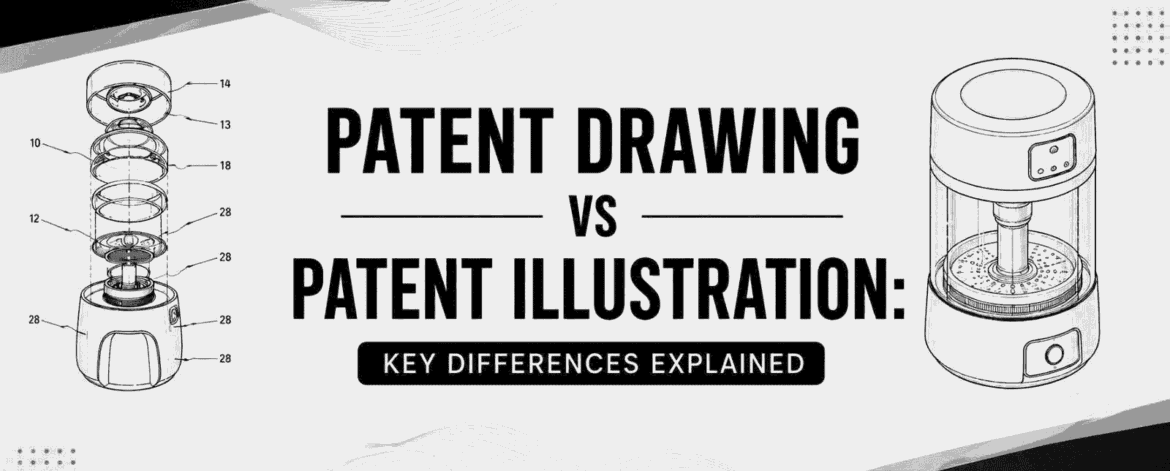
For example, a formal patent drawing of a new machine may show multiple components with reference numbers. An illustration of the same machine may show how the product looks in actual use.
Both visuals are valuable, but they answer different questions.
Patent Drawing vs Patent Illustration: Style and Appearance
Another important difference between Patent Drawing vs Patent Illustration is visual style.
Patent drawings usually have a clean and technical appearance. The focus is on accurately showing relevant parts of the invention. Lines, shapes, views, and reference characters are used to communicate technical information.
Patent illustrations can provide greater creative flexibility. Depending on the purpose, they may include realistic rendering, colors, shadows, digital effects, or presentation-style graphics.
A visually attractive illustration can be useful when explaining a complicated product to someone without technical knowledge. However, visual attractiveness alone does not make an illustration suitable for patent filing.
That is why inventors should understand Patent Drawing vs Patent Illustration before preparing figures for a patent application.
Technical Accuracy Is Important
Technical accuracy is essential in both patent drawings and patent illustrations, but the required level and purpose of accuracy may differ.
A patent drawing should accurately communicate the features described in the patent application. Important components should be visible and understandable.
Professional patent drawing preparation may involve reviewing the invention description and identifying the views needed to communicate important features.
Reference numbers should also correspond correctly with the written description where they are used.
In Patent Drawing vs Patent Illustration, patent drawings generally place greater emphasis on formal technical communication, while illustrations may prioritize visual explanation.
Filing Requirements and Formal Standards
Patent offices have requirements for drawings submitted with patent applications. Depending on the jurisdiction and application type, rules may address issues such as margins, figure numbering, line quality, reference characters, symbols, and acceptable visual formats.
Organizations such as the United States Patent and Trademark Office, the EPO, and WIPO have established procedures related to patent documentation.
Because requirements can differ between jurisdictions and application types, inventors should ensure their drawings are prepared for the appropriate filing requirements.
A patent illustration prepared for a website or business presentation may not automatically meet the requirements for a formal patent application.
This is another major consideration in Patent Drawing vs Patent Illustration.
Patent Drawing vs Patent Illustration for Utility Patents
Utility patents often require drawings that clearly explain how an invention is constructed or operates.
For example, a mechanical device may require several figures showing its external appearance, internal structure, and individual components.
Patent drawings may include exploded views or sectional views to explain complex relationships between components.
A patent illustration may present the same device in a simplified or visually enhanced format. This can be useful for presentations but may not provide all the technical information required for patent documentation.
When preparing a utility patent application, understanding Patent Drawing vs Patent Illustration can help determine which visual approach is appropriate.
Patent Drawing vs Patent Illustration for Design Patents
The difference between Patent Drawing vs Patent Illustration is also important for design-related protection.
A design patent focuses on the visual appearance of a product. The views included in the application play an important role in communicating what is being claimed.
Different views may be required to show the complete appearance of the design. Details such as solid lines, broken lines, and shading can also communicate important information.
Because the drawings can define the scope of visual protection, accuracy and consistency are particularly important.
An artistic product illustration may be useful for advertising, but it should not be assumed that a marketing illustration can replace professionally prepared design patent drawings.
When Is a Patent Illustration Useful?
Patent illustrations are useful when the objective is communication rather than formal filing documentation.
Businesses may use illustrations for:
- Investor presentations
- Product demonstrations
- Marketing campaigns
- Licensing discussions
- Company websites
- Product catalogs
- Educational materials
An illustration can show an invention in a realistic environment. For example, a medical device may be illustrated in a clinical setting, or a consumer product may be shown being used by a customer.
This type of visual presentation can make an invention easier to understand quickly.
However, the differences in Patent Drawing vs Patent Illustration should always be considered when preparing visuals for multiple purposes.
Why Professional Preparation Matters
Professional visual preparation can help inventors avoid confusion between technical patent documentation and presentation graphics.
Poorly prepared figures can create several challenges. Important details may be unclear, components may not be shown consistently, or the visual information may not match the written description.
Professional patent draftsmen understand how to organize complex technical information into clear figures.
At The Patent Drawing Services, drawings are prepared with attention to clarity, consistency, and the technical details of the invention.
Professional preparation can be especially helpful when an invention involves mechanical components, electronic systems, software processes, medical devices, consumer products, or complex assemblies.
Patent Drawing vs Patent Illustration: Which One Do You Need?
The answer depends on how the visual will be used.
If the purpose is to support a patent application, you generally need technical patent drawings prepared according to the requirements relevant to your filing.
If the purpose is to explain the invention to customers, investors, or business partners, a patent illustration may provide more flexibility and visual impact.
In some situations, both may be useful.
For example, an inventor can use formal patent drawings for the application and separate professional illustrations for a product presentation.
The key to Patent Drawing vs Patent Illustration is understanding that one visual format does not always serve every purpose.
A Simple Comparison
Patent Drawing vs Patent Illustration can be understood by comparing their primary objectives.
A patent drawing focuses on technical documentation and communication of an invention within a patent application.
A patent illustration focuses on explaining, presenting, or visually communicating an invention to a wider audience.
Patent drawings generally follow formal requirements, while illustrations may allow greater creative freedom.
Patent drawings prioritize technical clarity. Patent illustrations can prioritize simplicity, visual impact, or realistic presentation.
Both can be useful, but the correct choice depends on the intended use.
Final Thoughts
The discussion of Patent Drawing vs Patent Illustration is important because inventions often need different types of visual communication at different stages.
A technical drawing can support the patent application and help explain important features of the invention. A professional illustration can help present the invention to investors, customers, manufacturers, or licensing partners.
Before preparing any visual material, inventors should first determine its purpose. If the visual will become part of a patent application, technical accuracy and applicable filing requirements should be considered carefully.
The Patent Drawing Services provides professional support for inventors, law firms, and businesses that need clear and high-quality patent visuals. From utility patent drawings to design patent drawings and technical illustrations, professional preparation can help communicate an invention accurately and effectively.
Choosing the right approach begins with understanding Patent Drawing vs Patent Illustration and recognizing how each type of visual serves a different purpose.