A strong patent application depends on more than innovative ideas and carefully written claims. Every part of the application must communicate the invention clearly, and the drawings often play a major role in that process. Professional Patent Drawings provide visual details that help patent examiners, attorneys, inventors, and other readers understand how an invention works or what it looks like.
Whether you are preparing a utility patent, design patent, or certain types of trademark applications, accurate illustrations can make the filing clearer and more effective. Poorly prepared drawings may create confusion, require corrections, or contribute to examination delays. By contrast, Professional Patent Drawings can improve clarity, consistency, and compliance with applicable patent office requirements.
What Are Professional Patent Drawings?
Professional Patent Drawings are technical illustrations created specifically for use in intellectual property applications. They are different from ordinary product images, marketing graphics, engineering sketches, or presentation diagrams.
Patent drawings must communicate the relevant features of an invention while following applicable formal requirements. Depending on the invention, drawings may include:
- Front, rear, top, bottom, and side views
- Perspective views
- Enlarged views
- Cross-sectional views
- Exploded views
- Flow diagrams
- Electrical or technical schematics
- Reference numerals and figure numbers
The purpose is not simply to make an application look professional. The drawings should accurately disclose the invention and remain consistent with the written specification.
Why Accuracy Matters in Patent Drawings
Accuracy is one of the most important qualities of a patent illustration. A drawing that leaves out an important component or shows a feature incorrectly can create questions during examination.
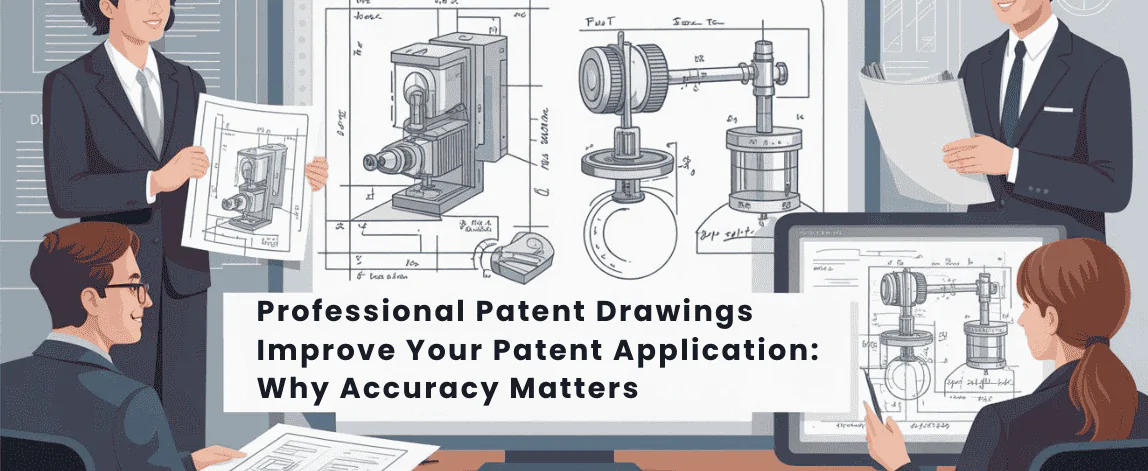
Professional Patent Drawings help present technical information in an organized and understandable manner. When the drawings and written description accurately correspond, readers can more easily identify the relationships between different components.
For example, a mechanical invention may require several views to demonstrate how individual parts connect. An electronic invention may need diagrams showing circuits, components, or system relationships. A software-related invention may use flowcharts or system diagrams where appropriate.
The right drawing approach depends on the invention and the disclosure required by the application.
How Professional Patent Drawings Improve Your Application
1. Improve Technical Clarity
Some inventions are difficult to explain entirely through words. A well-prepared illustration can communicate structures, shapes, relationships, and arrangements more efficiently.
Professional Patent Drawings provide a visual reference that complements the written specification. Instead of requiring the reader to interpret every structural detail from text, the drawing can make important relationships easier to understand.
2. Support the Written Specification
Patent drawings and written descriptions should work together. Figure numbers and reference numerals are commonly used throughout a patent application to connect the illustrations with the relevant portions of the specification.
When a component is identified consistently in both the drawings and written description, the application becomes easier to follow. Professional Patent Drawings help maintain this consistency across multiple figures.
3. Reduce Avoidable Drawing Problems
Patent applications can encounter drawing-related issues when illustrations contain missing views, inconsistent reference numbers, unclear lines, or other formal deficiencies.
Using Professional Patent Drawings can help identify and correct these issues before filing. This can reduce unnecessary revisions and make the application preparation process more efficient.
4. Present the Invention More Effectively
An invention may contain numerous components or technical relationships. A professionally prepared set of figures can organize that information into logical views.
For example, an exploded view can demonstrate how components fit together, while a cross-sectional view can reveal internal structures that are not visible from the exterior.
This visual organization is one reason Professional Patent Drawings are valuable during patent preparation.
Common Patent Drawing Mistakes
Applicants who create their own drawings without understanding patent requirements may encounter several common problems.
Missing Necessary Views
One image may not adequately disclose every relevant aspect of an invention. Depending on the subject matter, additional views may be necessary to clearly represent the structure or appearance.
Inconsistent Reference Numerals
Reference numerals should be used consistently. If the same component has different numbers in different figures, it can create unnecessary confusion.
Poor Line Quality
Patent illustrations generally require clean and precise line work. Uneven, blurred, or cluttered lines can make technical details difficult to interpret.
Incorrect Proportions
Figures should provide an accurate representation of the invention. Poor proportions or distorted components can make an illustration less useful.
Unnecessary Information
Patent drawings should focus on relevant disclosure rather than decorative or marketing elements. Extra visual information can make figures harder to understand.
Working with experienced professionals helps address these concerns before the application is submitted.
Professional Patent Drawings for Utility Patents
Utility patents generally protect the functional aspects of an invention. Depending on the technology, the application may require several different types of figures.
Professional Patent Drawings for utility inventions may include:
- Mechanical assembly views
- Component diagrams
- Cross-sectional illustrations
- Exploded views
- Process diagrams
- Flowcharts
- Electrical circuit representations
- System architecture diagrams
The goal is to provide useful visual disclosure that supports the invention described in the application.
Professional Patent Drawings for Design Patents
Design patents focus on the ornamental appearance of an article. Because the drawings can play a central role in defining what is being protected, precision is particularly important.
A design patent application may require multiple views, such as front, rear, top, bottom, left, right, and perspective views, depending on the subject matter.
Professional Patent Drawings for design applications must carefully represent the claimed appearance. Features shown with solid or broken lines can have different purposes, so they should be used appropriately according to the applicable filing requirements.
Shading, contours, proportions, and consistency between views can also affect how clearly the design is represented.
Professional Patent Drawings and International Filings
Patent applications may be filed through different national or international systems, and drawing requirements can vary depending on the filing route.
Inventors and patent professionals may work with organizations and offices such as the USPTO, EPO, and WIPO. Preparing drawings with applicable standards in mind can make international filing workflows easier to manage.
However, requirements should always be reviewed for the specific jurisdiction and application type. Professional Patent Drawings should be prepared according to the requirements applicable to the intended filing.
Benefits of Hiring Professional Patent Illustrators
Professional patent illustrators bring technical knowledge and experience to the drawing process. Their work can provide several practical benefits.
Better Accuracy: Experienced illustrators can translate sketches, CAD files, photographs, and technical information into clear patent figures.
Improved Consistency: Multiple figures can be prepared with consistent line quality, numbering, proportions, and visual presentation.
Greater Efficiency: Professional support can save inventors and attorneys time during application preparation.
Fewer Revisions: Reviewing figures against the application requirements before filing can help identify avoidable problems.
Confidential Handling: Professional service providers can establish appropriate processes for handling sensitive invention information.
How Inventors Can Help Prepare Better Drawings
Inventors can make the illustration process easier by providing complete technical information. Useful materials may include CAD files, engineering sketches, product photographs, existing diagrams, and written explanations.
Inventors should also identify the most important features of the invention and explain how individual components interact. Reviewing draft Professional Patent Drawings carefully is another important step.
The inventor or patent attorney should confirm that the figures accurately represent the invention and correspond with the written application before filing.
Why Choose The Patent Drawing Service?
At The Patent Drawing Service, our focus is on creating accurate and application-ready patent illustrations for inventors, businesses, attorneys, and law firms.
Our services include:
Our illustrators work to create Professional Patent Drawings that clearly represent inventions while considering applicable requirements. Each project can be reviewed for consistency, clarity, numbering, and overall technical presentation.
Final Thoughts
Patent drawings are an important part of communicating an invention. They can clarify technical structures, support the written specification, and help readers understand features that may be difficult to explain with words alone.
Accurate Professional Patent Drawings can also help reduce avoidable drawing problems and create a more organized patent application. Whether you are preparing a utility patent, design patent, or another intellectual property filing, the quality of your illustrations deserves careful attention.