When filing a utility patent application, one of the most powerful tools you have—aside from a well-written specification—is the patent drawing. While not always strictly required, patent drawings are highly encouraged by the USPTO because they bring your invention to life. They help patent examiners, attorneys, and even juries in infringement cases understand exactly what your invention is and how it works.
In this blog, we’ll break down the most common types of utility patent drawings and when to use each.
Why Utility Patent Drawings Matter?
Before diving into the types, it’s worth noting why utility patent drawings are so important. Unlike design patents, which focus on ornamental appearance, utility patents cover how something works. A well-drafted drawing can clarify complex mechanisms, show relationships between parts, and even strengthen your patent’s enforceability. In short, a picture here isn’t just worth a thousand words—it could be worth thousands of dollars in legal protection.
Types of Utility Patent Drawings
1. Mechanical Drawings
Mechanical drawings are the most common type of utility patent illustration. These are precise, scale-accurate representations of an invention’s physical structure. Unlike rough hand sketches, mechanical drawings are typically created using professional engineering software such as AutoCAD, SolidWorks, TurboCAD, or CorelDRAW.
Best for: Machines, tools, engines, consumer products, and any invention with moving or interconnected parts.
Key feature: Multiple views (front, side, top, isometric) and reference numbers pointing to specific components.
2. Sketches
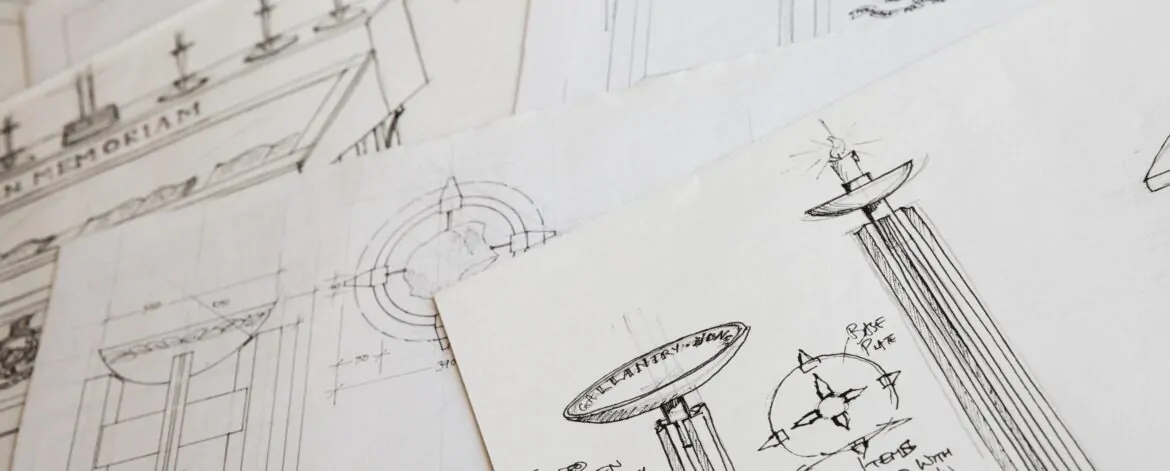
Sketches are freehand drawings, often used in provisional patent applications where speed and cost are priorities. While less formal than mechanical drawings, sketches must still be clear, legible, and meet basic USPTO guidelines (e.g., black ink on white paper, no color).
Best for: Early-stage inventions, provisional applications, or concept explanations.
Key feature: Simplicity and flexibility—no software required.
3. Flowcharts
If your invention involves a method, process, or software algorithm, you’ll likely need a flowchart. Flowcharts use standardized symbols (diamonds for decisions, rectangles for steps, etc.) to show the sequence of operations.
Best for: Business methods, software patents, chemical processes, and manufacturing methods.
Key feature: Step-by-step logical flow, often accompanied by a written method claim.
4. Block Diagrams
Block diagrams are widely used in electrical, software, and system-level patents. Instead of showing every tiny component, they use labeled blocks to represent major functional elements and lines to show how those elements connect or communicate.
Best for: Computer systems, network architectures, control systems, and signal processing.
Key feature: High-level system overview without excessive detail.
5. Electric Circuit Diagrams
Circuit diagrams (or schematic diagrams) are a specialized form of patent drawing used for electrical inventions. They use industry-standard symbols for resistors, capacitors, transistors, integrated circuits, and more to show exactly how an electrical circuit is built.
Best for: Electronic devices, power supplies, sensors, and embedded systems.
Key feature: Symbol-based representation with clear connectivity paths.
6. Graphs and Charts
Less common but still valid, graphs and charts can be used as patent drawings when the invention relates to data trends, performance comparisons, or experimental results. For example, a patent for a new battery technology might include a graph showing voltage over time.
Best for: Scientific inventions, chemical patents, pharmaceutical formulations, and material science.
Key feature: Data-driven visual evidence supporting functional claims.
Final Overview
Whether you’re filing a provisional or non-provisional utility patent, including the right type of drawing can make or break the clarity of your application. Mechanical drawings and block diagrams dominate the field, but flowcharts, circuit diagrams, and even simple sketches all have their place depending on your invention.
Remember: patent drawings are often the first thing an examiner looks at. If your drawings clearly tell the story of your invention, you’re already halfway to approval. So choose the right type, follow USPTO formatting rules, and let your visuals do the heavy lifting.